
Spotlight on Victor Dean
Victor Dean, an award-winning writer, producer, director, and actor, has been telling stories since childhood. After completing our Film & TV Industry Essentials and Acting Essentials: Preparing for a Role courses, he turned a deeply personal idea into Spirit Walkers, a short screenplay that won Best Short Script at the 2026 Nashville Film Festival.
You’ve completed two Yellowbrick programs, Film & TV Industry Essentials and Acting Essentials: Preparing for a Role. What led you to each, and how did they complement one another in your work as a writer and director?
My journey through the NYU Tisch Film & TV Industry Essentials and Juilliard Extension Acting Essentials programs was both a professional investment and the fulfillment of a dream I’ve carried since childhood. Growing up and attending one of the premier Performing Art Schools, I knew that NYU Tisch School of the Arts and The Juilliard School were two of the most respected institutions in the performing arts and entertainment industry. Even as a grade-school student, I dreamed of attending these schools. They represented artistic excellence, creativity, and the opportunity to learn from some of the best minds in the industry. So, when I discovered that Yellowbrick offered educational programs in collaboration with these institutions, I saw an opportunity to pursue something that had inspired me for much of my life.
NYU Tisch Film & TV Industry Essentials was a natural starting point because storytelling has always been at the heart of my creative ambitions. As a writer and director, I wanted to deepen my understanding of filmmaking beyond the creative process itself. I was interested in learning more about the business of film and television, including how projects are developed, produced, marketed, and ultimately brought to audiences. The program gave me a broader perspective on the industry and reinforced the importance of understanding both the artistic and practical sides of filmmaking.
One of my biggest takeaways was recognizing that creating a compelling story is only one part of the journey. A filmmaker must also understand how to position that story, communicate its value, collaborate with others, and navigate an industry that is constantly evolving. That perspective has been particularly valuable as I continue developing my own projects, including my award-winning short screenplay, Spirit Walkers. The program encouraged me to think not only as a writer and director but also as a filmmaker responsible for guiding a project from its earliest concept to its eventual audience.
Juilliard Extension Acting Essentials complemented that experience by bringing me closer to the emotional and human side of storytelling. Acting was my first love from a young age, but I pivoted my passion for storytelling to writing and directing after becoming medically disabled. Although my primary focus has shifted, as a director, I’ve always believed that understanding an actor’s craft is essential to interpreting characters, discovering motivations, developing emotional connections, and bringing authenticity to performances.
The Juilliard program offered an opportunity to explore storytelling from the performer’s perspective. It helped me think more deeply about character development, emotional truth, intention, and the relationship between an actor and the material. As a writer, that perspective encourages me to create characters with greater depth, believable motivations, and dialogue that feels natural rather than simply serving the plot. As a director, it reinforces the importance of communicating clearly with actors, respecting their creative process, and creating an environment where meaningful performances can emerge.
What makes these two programs so valuable together is that they approach storytelling from opposite ends of the same creative process. NYU Tisch helped broaden my understanding of the industry and the larger framework required to bring a film to life. Juilliard helped me focus on the intimate details that make a story emotionally compelling, particularly the relationship between the character, the actor, and the audience.
One program strengthened my understanding of how to make a film, while the other deepened my appreciation for how to make an audience feel something.
Tell us about Spirit Walkers. What inspired the story, and what was the writing process like?
Spirit Walkers is a historical drama with supernatural elements set in 1943 Mississippi, during the Jim Crow era. The story follows a ten-year-old Black boy whose grandfather introduces him to an extraordinary ancestral gift passed down through generations. What begins as a journey between a grandfather and grandson becomes a powerful story about survival, identity, courage, and the importance of understanding where we come from. The inspiration came after watching Ryan Coogler’s award-winning film Sinners. I was captivated by the strength of the storytelling, the richness of the characters, and the way Coogler blended African American history, cultural identity, and supernatural elements into something so original and compelling. The film challenged me creatively. I remember thinking, ‘Could I write something just as powerful?’ Not to imitate his work, but to push myself as a storyteller and see what I was capable of creating.
I remembered hearing a famous writer once say, ‘When you start writing, start with something you know.’ So that’s exactly what I did. I began with something deeply personal: my relationship with my grandfather. I reflected on the bond we shared, the wisdom he passed down, and the lessons older generations teach us, often without realizing how much those lessons will shape our lives. That relationship became the emotional foundation of Spirit Walkers. From there, I began exploring an intriguing possibility: What if the wisdom passed down through generations was more than knowledge? What if it was an extraordinary gift that helped our ancestors survive unimaginable circumstances? And what if a young boy discovered that he possessed this gift at the very moment his life depended on it? From there, my imagination took over, and the rest is history.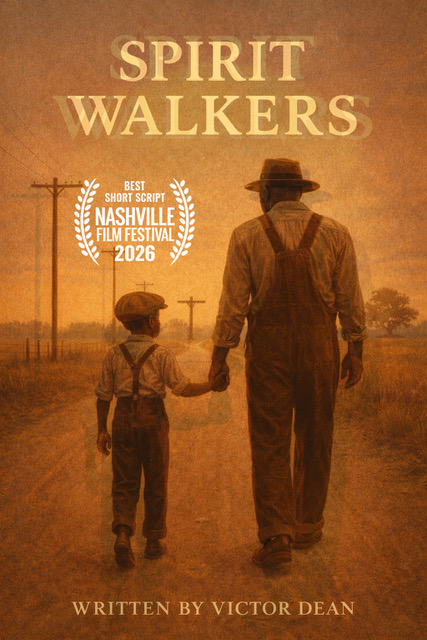
The writing process was an exercise in discipline, simplicity, and trusting my creative instincts. Because Spirit Walkers is a short film, I had to be intentional with every scene, line of dialogue, and visual moment. One of my biggest challenges was balancing the historical reality of Jim Crow Mississippi with the supernatural elements of the story. I wanted the dangers facing the characters to feel authentic while allowing the supernatural gift to represent something much deeper: the resilience, resourcefulness, and strength that African American families have passed down through generations. I also wanted the audience to experience the story through the eyes of the young boy, allowing his innocence, fear, and eventual understanding to drive the emotional journey. As both a writer and director, I believe some of the most powerful storytelling happens in the quiet moments when an audience is given the space to feel rather than simply being told what to think.
What has made this experience particularly rewarding is seeing a personal creative challenge evolve into an award-winning screenplay, including receiving Best Short Script honors at the 2026 Nashville Film Festival. That recognition has been incredibly encouraging, especially knowing the story began with a simple idea and a personal connection to my grandfather. Ultimately, Spirit Walkers is about more than a supernatural ability. It’s about family, ancestral knowledge, and the extraordinary strength we inherit from those who came before us. I started writing Spirit Walkers because Sinners challenged me to become a better storyteller, but what emerged was something uniquely my own. For me, that’s the beauty of storytelling. Sometimes the most extraordinary ideas begin with the people and experiences we know best.
Was there a particular lesson or module from either course that shaped how you approached Spirit Walkers?
The Character Development module was particularly valuable in shaping how I approached writing Spirit Walkers. As a trained actor who has studied the craft from grade school through high school, college, and graduate-level work, I’ve always believed that truly understanding and embodying a character is paramount to authentic storytelling. My acting background has profoundly influenced how I approach writing. I don’t simply create characters and assign them dialogue. I try to become those characters, understand their motivations, experience their emotions, and see the world through their eyes. That’s how I’ve always approached the creative process, and the Character Development module reinforced the importance of that connection between the writer, the character, and the audience.
One of the most important lessons reinforced through the coursework was that compelling characters are defined by more than their dialogue. Their motivations, internal conflicts, relationships, and emotional responses are what make them believable. That understanding was especially important in Spirit Walkers because the screenplay is only seven pages long. With such limited time, every character interaction had to carry emotional weight and move the story forward. I had to trust the audience to recognize what the characters were feeling, even when those emotions weren’t explicitly expressed. My acting training helped me appreciate the importance of subtext, body language, silence, and those subtle moments that often communicate more than words ever could.
Ultimately, the Character Development module strengthened an approach to storytelling that I’ve been developing throughout my life as an actor, writer, and director. I believe that to write a character convincingly, you must first be willing to inhabit that character both emotionally and psychologically. That’s what I brought to Spirit Walkers. My goal wasn’t simply to tell a compelling supernatural story set during Jim Crow America. I wanted to create two believable human beings whose relationship audiences could recognize, understand, and emotionally connect with. The supernatural elements provide the intrigue, but it’s the humanity of the characters that gives the story its heart. For me, that’s where great storytelling begins.
How did studying acting through Juilliard Extension influence the way you write and direct?
Acting was my first love, and having studied the craft from grade school through graduate-level work, I’ve always approached storytelling through the eyes of an actor. Studying through Juilliard Extension reinforced something I’ve believed for years: before I can write a character, I have to become that character. I need to understand their emotions, motivations, fears, and even what they’re not saying. That’s how I write. As a director, that same understanding helps me connect with actors, communicate more effectively, and guide authentic performances. Juilliard didn’t change how I approach storytelling. It strengthened my creative instincts and reminded me why I fell in love with acting in the first place.
What message would you most like to share with aspiring writers and filmmakers who are looking for their own breakthrough?
The most important advice I can share is find your tribe and don’t ever give up on yourself or your dreams. After I became disabled, my wife gave me some advice that changed my life. She told me to get up, get out there, and find my tribe, people who shared my passion, understood my creativity, and could help me grow. That advice became the turning point in my journey. Yellowbrick, NYU Tisch, and Juilliard became part of that tribe, helping me rediscover my confidence, strengthen my craft, and reconnect with my purpose as a storyteller. I learned that sometimes a breakthrough isn’t about waiting for someone to open a door. It’s about finding the courage to get up, surround yourself with the right people, and create your own opportunities. Your circumstances may change, but your dreams don’t have to.
What has been the most rewarding part of this experience so far?
Without question, the most rewarding part has been the opportunity to learn. I love to learn, and I believe that no matter how much experience you have, there’s always something new to discover. Through Yellowbrick, NYU Tisch, and Juilliard Extension, I’ve been able to build on my knowledge, challenge myself creatively, and grow as a writer and director. For me, learning isn’t just about gaining new skills. It’s about staying curious, keeping my imagination alive, and continuing to evolve as an artist. That’s what makes this journey so rewarding.
What’s next for you creatively, and is there anything coming up for Spirit Walkers (festivals, production, etc.) that you’d like us to mention?
Creatively, I have several exciting things in the works. I’m currently in post-production on an animated short film based on a children’s book I wrote, Maria and the Turtle, which I published last year. Meanwhile, Spirit Walkers is still making its way through the film festival circuit, and I’m actively applying for grants to bring the story to life as a live-action short film. One of my personal goals is to play the grandfather, a role that would bring me full circle, reconnecting my love of acting with my passion for writing and directing. I’m excited about what lies ahead, and I hope audiences will get to experience both projects soon. Keep a lookout for Spirit Walkers!
What would you tell someone considering a Yellowbrick course?
My grandfather used to tell me, ‘You don’t have an idea until you write it down.’ I’ve carried those words with me throughout my life, and I think they apply perfectly to anyone considering a Yellowbrick course. You can spend years thinking about what you want to do, but at some point, you have to take that first step. For me, Yellowbrick was about turning ambition into action, investing in myself, and continuing to grow as an artist. My advice is simple: Don’t just dream about what you want to accomplish. Write it down, take that first step, and give yourself the opportunity to make it happen.
Learn more about Victor’s work at victordean.com.
Victor’s story shows what’s possible when imagination meets the right education. For a closer look at the programs that helped shape his work, check out Film & TV Industry Essentials from NYU Tisch and Yellowbrick and Acting Essentials: Preparing for a Role from Juilliard Extension and Yellowbrick.