Costing the Product: The Costing Process

Costing a product is a full-time job and usually takes many people. You can look at costing in a couple of different ways. As a merchandiser, let’s say you had 10 styles, and we wanted to have a certain markup. If you’re selling within your own stores, you usually want at least a 75% to 85% internal markup. If you want to retail a jacket for $695, and you already know that your landed cost needs to be 20% of that to get your 80% markup.
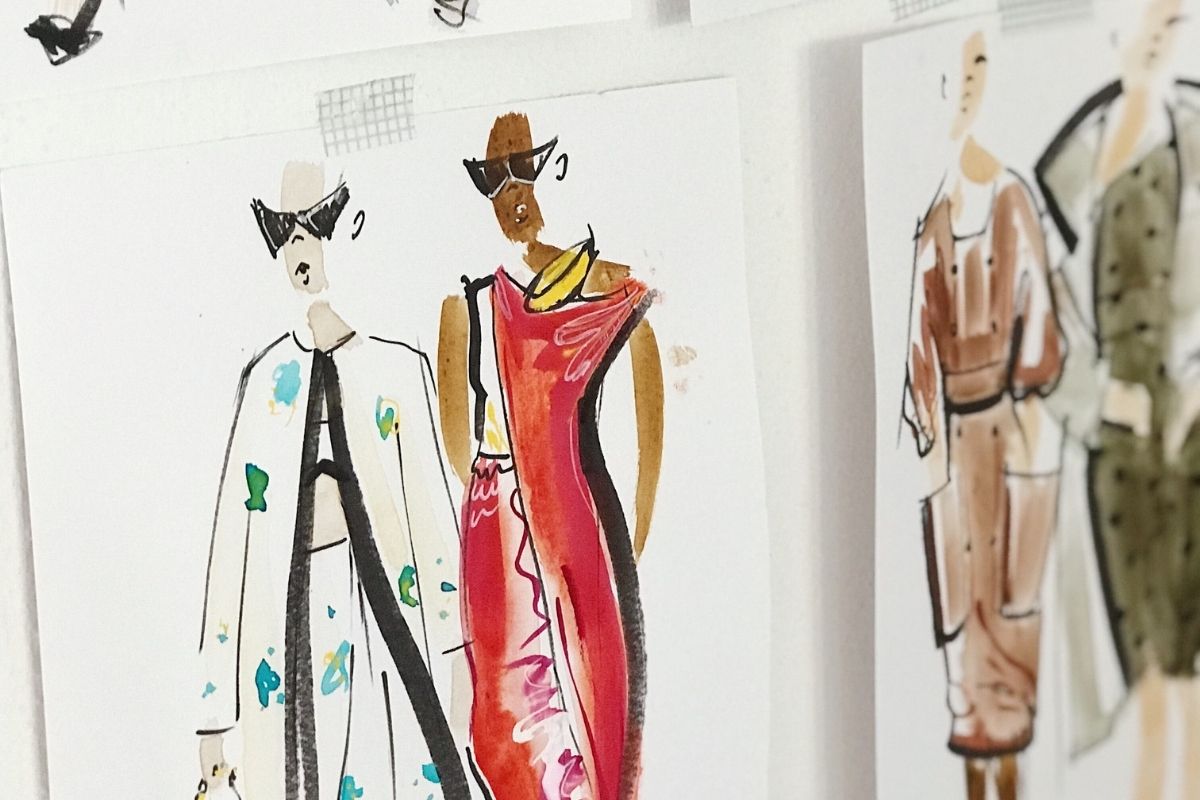
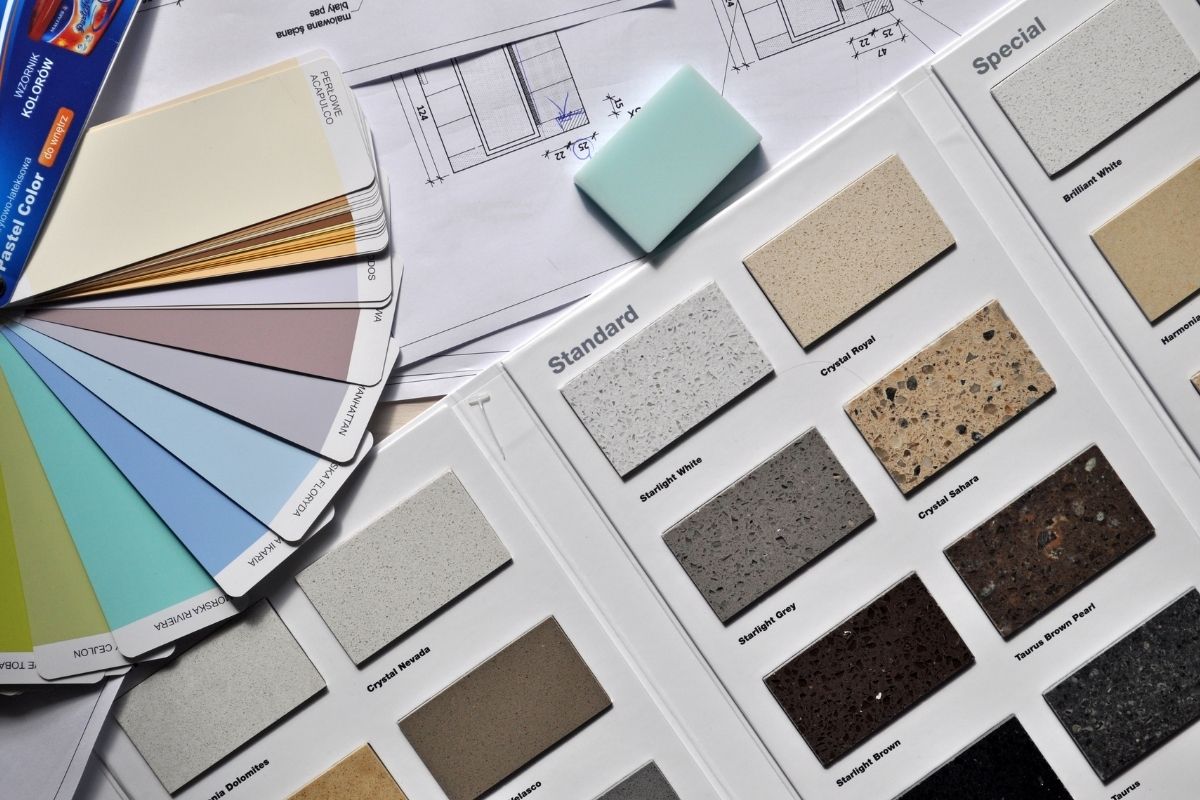
A designer wants this beautiful satin made in Italy. When you’re looking at the cost of goods, around 70% is the raw materials, like the thread, the trim, and the zipper or button. A designer goes to Premiere Vision and finds the most beautiful Italian satin they want to use. If you are going to get the 75% or 80% margin you want, the jacket is going to be $1500 compared to the $695 or the $595 you wanted.
You go back to the design team and tell them that if the market can’t retail nor our brand can retail a jacket this high, there’s no the cost value is not there. Start taking things out of it. Can we counter source material in another country that looks and feels the same but not the higher quality? Can we take a few pockets off of it to lower the cost?
Let’s say a loss leader is the one item that is the showstopper—the most fashionable piece. You need it to draw everyone in to look at the collection, but you already know you’re going to get a lower margin on it. It might be 40% or 50%. You’re going to do a few units, but the other nine styles are going to have higher margins. That’s a trick that all fashion brands use. It’s called blended costing. They look at key items, but they also look at it as blended because ultimately, it’s the blended total that really makes a difference.

Creating an Online Presence: Branding in the Digital Age: Branding in the Digital Age

Branding is a unique opportunity for entrepreneurs.

In today’s world, there are so many ways an entrepreneur can use branding to strengthen their business. For little to no cost, entrepreneurs can post branded content across social media platforms to sell product and grow their business.

The Branding Challenge

The challenge with branding, however, is that it can be difficult for entrepreneurs to be creative and come out with unique and differentiated content. As a low-cost strategy, many entrepreneurs are using branded content, and this is saturating the market and creating more competition. Entrepreneurs will publish great content on social only to find that they are only gaining a few likes and not generating the attention and engagement they need to sell product and successfully run their business. To be successful, entrepreneurs need a couple hundred thousand, or millions, of likes to achieve significant business growth.

TikTok is the Latest Dream Machine for Marketers

With global popularity, TikTok is gaining traction as one of the most popular platforms for advertisers. With 15 seconds to capture consumers’ attention, advertisers are leveraging music and parading to something fashionable to develop memorable branded content.

It’s a common human trait that we can receive information faster that we can send it, so in 15 seconds brands have enough time to tell their whole story, brand it, and repeat it umpteen million times. And the best part? It cost literally nothing.

The catch, however, is that to be successful on TikTok, you need to be more creative than the next guy. With so many brands fighting for consumer attention, your content must be differentiated and unique to be successful. So, for all the entrepreneurs looking at low-cost solutions to share their brand message, TikTok is a great option. But you must be that much more creative to succeed.

UX Design: Making Dynamic Prototypes

In the next stage, you add a little bit of dynamics to your prototype to figure out what is the best way to create this conversation. You start by looking at different elements, including animation, colors and images. By adding dynamics, you can also start to go to the specific person that you’re designing for to seek more input. After all, at that stage, you want to have a very specific scenario in mind as well.

UX Design Prototype Feedback

When you go to a person and you design a system, such as a map for a person who wants to go from Point A to Point B, the user flow that you create should have a very specific scenario so that you can have a person try out your system or the prototype. For example, they might try out one that has colors, one that has animation or one that is dynamic in other ways. The user can actually try to use that system to help them go from Point A to Point B.

If they’re successful, your prototype is successful. If they’re not successful, and more often than not they won’t succeed with your UI in the first few stages of the prototype’s design, you have to ask yourself: Where did they come across a UX problem? Did they fail when they tried to press a button because they interpreted the button as text and not as a button? Did they fail because they interpreted the image as something that conveyed too much information and looked more like text? Did they fail to enter the information into a text box because the text box was just too small?

These are the things that you can identify in your UI design with a digital, high-fidelity prototype. When you allow this type of interaction with one or more users, the results convey to you the exact areas in which your prototype is failing. You then have to decide how best to reverse course and quickly refine the prototype so that you can try again to see if a user can accomplish that task.

As you’re learning through your online UX design education studies, a prototype gives you the ability to do something that you don’t have to fall in love with and can even throw away. A prototype allows you to more successfully get to the goal of designing a simple pleasurable application.

Distribution & Fulfillment Channels: Fast Fashion: Distribution Disruption as Business Model

Fashion is changing rapidly and speed to market is a huge part of this transformation. In the past few years in fast fashion we’ve seen a lot of disruption, decentralization, and Instagram monetization.

Think about the original fashion business supply chain and how it’s been set up with department stores and a push model of the industry deciding what’s available and what we’re going to wear. Everyone was shopping in malls to engage with products.

Today, we’re operating more on a pull model where customers can tell us more about what they want. We’ve seen retailers like Zara, Forever 21, and H&M operate in this model of what we consider fast fashion. The real difference is the speed to market and the time it takes for the production process for that product to make its way to a floor.

Zara has been able to innovate and engage with feedback loops and speed up the process to market. Engaging in smaller batch manufacturing is helpful when you’re competing for space on a manufacturing line. It takes more effort and resources to produce 30,000 garments in one place versus spreading out demand in several factories since you’re competing with other retailers and brands to get manufacturing facility space and capacity.

Using fashion education, you can pivot more quickly when you’re dealing with fewer units. There’s opportunities to use customer feedback to shorten production lead time.There are so many points in the supply chain where, when you’re dealing with less units, it becomes easier for stores to more quickly funnel their product.

In historical department store retail, it could take six to nine months to go through this process. Fast fashion really disrupted that process and we no longer have to wait for the season to end to continue iterating, innovating, and ultimately bring newness on our time.

What Is Agility in Terms of UI Design?

“An agile workflow is all about iteration and moving quickly”, Camara explains. The best way to go about agility when working on a UI assignment is to implement design sprints. Design sprints are typically two-week spans in which you are to complete as much as possible before moving on to the next sprint. Waterfall, however, is a process that’s based more on phases. So, when carrying out this process, you would then be working through your project by completing each phase at a particular time. Also, there is no specific timeframe for each phase, but as you get through them, you would essentially be making your way through the finish line as well.

Ultimately, agile development refers to the division of labor, the division of milestones, and the kind of path that is taken from A to Z. You can learn about this entire process in detail through online UX design education.

Why an Agile Workflow Is so Beneficial Nowadays

The old-school way of doing it called for designers to take six months, a year, or even three years before having something new to show. And though we can keep that as an ultimate goal, agility proves to us that by conquering smaller milestones on a regular basis, you will always have something fresh to show. In fact, your software might not even be finished, but you can still present some of its workings rather than leaving the engine open until all of the parts are ready. As you develop your UI design, you can say, “Hey, this part of the engine is that”, or “This part of the engine is already done”, allowing your productivity to be known as you work towards the completion of your UX design.

Working little by little will help you to paint the perfect picture or narrative because your creation will be constantly testing itself against the people who will soon be using it.

So, the idea of having something to show, whether it’s your funders, your current group of test users, your classmates, or even an active research group, gives you the unique advantage of receiving consistent input so that you will have a better idea as to which path you’re taking and what it’s meant to do. That kind of invaluable UX feedback will help you stay on track and put you on a greater level of success.

Ecommerce Concepts & Models: Business Website Basics

Today, every brand has a website. They have a web presence of some sort. I believe your website should provide precisely what your customers, or tribe, are looking for.

Many businesses use e-commerce. However, the internet is a bit more educational. You can buy clothes on the web, but first, let us tell you about ourselves. We’ll show you how we sustainably make our products.

It becomes a component of marketing and romancing the customer with who you are and how you conduct business. Nobody wants to be more than a few mouse clicks away from making a purchase. You must make it simple and easy to use.

I believe that user-friendliness is the key. A lot of really high-end corporations, in my opinion, are really good at making attractive visuals. You go to the site, and it’s absolutely stunning, and it perfectly captures the look they’re after. However, if you can’t easily navigate from item to item or see the product’s information, you’ll discover abandoned carts more often than not. Alternatively, they could have simply given up and departed.

We’ve witnessed significant growth in online shopping. Even those I would never expect to embrace e-commerce, such as my parents and people in their eighties, have acclimated to it, and everyone is doing it this way. You’ll want to make sure that your website is simple to use however you put yourself out there.

Ecommerce Concepts & Models: Sales on Social Media

Social media is a world itself. But it also infiltrates the world we live in. I remember 2011 when Instagram first hit the social media scene—it was just a platform you could upload photos to. Who was looking at them? No one really knew. You were following people, but not really following them. Not many brands were on Instagram then, but now, the platform transformed into a marketplace from which you can now gain revenue.
It’s gone from uploading stagnant photographs, to now. Transactions can occur from uploading a single post. It’s phenomenal what Instagram has turned into. It’s changed the way people consume. People don’t just want to see your runway anymore, and say, “Oh, well, I guess I have to wait six months to buy that product, right?” Now, people are like, “I see it, I need to click it and purchase it right then and there, otherwise I’m gonna forget about it.”
Retail channels have become more open in terms of apps. For example, on Instagram, people can click the View Shop option and view the products you are selling, which leads them directly to the website where they can purchase the items. It’s a very easy process. In terms of conversion, I think that you know that our clients either go directly to the website, or we have private clients that buy from us through Far Fetch.
However, I think one of the most important things is to have accessibility. Therefore, the View Shop on Instagram is ideal for me. If someone wants to buy through there, great! It’s about that extra level of accessibility to maximize sales in the e-commerce industry.

What You’ll Learn in Online UX Design Education

My name is Tiago Valente, and I’m a creative director, strategist, designer and professor at Parsons The New School.

In this rapidly evolving and lucrative industry, employers from a variety of fields are looking for creative thinkers and innovators who can create new types of UI design. It is our goal to give you all the skills necessary to create compelling projects that will enhance your UI and UX design portfolio.

We’ll walk you through the crucial stages that will enable you to create compelling experiences and engaging interfaces. You will understand exactly what UX is about and what UI is about. What is the difference? What are the complements? What’s the background? Why do we behave in the way that we behave?

You will learn to look at your environment in much more detail using observation and many other skills. You’ll learn some of these skills in your online UX design education, but you’ll realize that you already have many of them.

We’ll guide you through all the stages that lead to a successful user experience journey while leading you to build your very own portfolio.

Ecommerce Concepts & Models: Wholesale or DTC?

Retail experienced a seismic during the onset of e-commerce. Many people claimed that wholesale was dead, that people were going to open their own stores. Why would you sell? The benefit of selling to a wholesaler is that you can take your product, sell it to them, and don’t have to worry about the product again, right? If it doesn’t sell, you don’t have to worry about what to do with it. You don’t have to worry about marking it down. You don’t have to worry about where you’re going to put it. You don’t have to worry about stock space. You sell it to them, and then it’s their problem—Nordstrom’s problem.
When you operate a store and sell directly to consumers, you must worry where you’re putting the product, where you’re housing the product, paying your employees, keeping lights on, rotating floor sets, all of those things. But generally, you have a bit higher margin when selling directly to the consumer than you would be selling to wholesale manufacturers.
The onset of the internet may have led people to believe, “Okay, I don’t have to have employees. I don’t have to keep lights on. I don’t have to do any of those things, and I can still sell direct to consumers, so it’s a win-win.”
It’s interesting that over the last decade and a half the shift has led to a direct-to-consumer sales model. That has placed some brands in a great position regarding the margin they can charge because if you’re selling directly to consumers, you’re not selling to a retailer that buys at price. A wholesale price, which is usually a markup price. For example, the product is marked at $50, and you sell it to them at $100, they then sell it to the consumer for $200.
So, if you’re selling directly to the consumer at $200, you’d see a 3X margin from what you were making with your wholesale account. And that’s very attractive. Wholesale accounts had been the norm for almost a hundred years. Older brands have wholesale accounts, and it’s been difficult for them to shift to a direct-to-consumer model because of that.