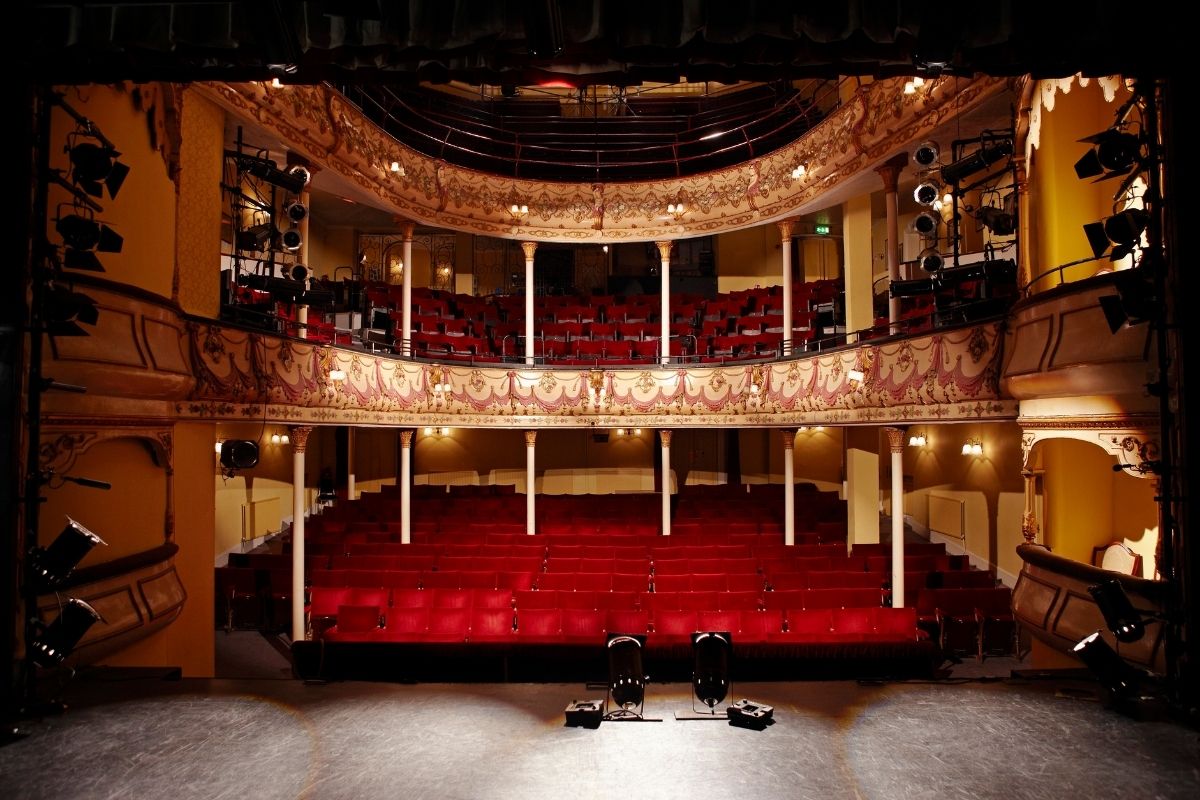
Online Performing Arts Education: Analyzing the Script

When you’re analyzing a script, I think you might do well to sort of pick one of those characters and track all those tensions, and then pick two characters and understand how the conflict’s happening. Then pick the family and understand where the conflict’s happening. It’s a show full of a lot of conflict. Characters are in conflict with each other, inside the family and outside the family.

On top of it, the mother decides that she’s going to buy a house. She’s going to buy a house in a white neighborhood. So, everybody has to ask, “What does it mean to, sort of, grow?” But there’s a plant that’s struggling to live, struggling to live in the sun, struggling to live in the sun like a raisin in the sun. Is it going to be the raisin or is it going to grow?

It doesn’t have a lot of sustenance, but it’s got love. It’s got attention. It’s got what the family can give it. So, on some level that’s what the show is about. It’s also about the family to sort of come apart in certain ways, so that they can then come together again. That’s what I think the play is about, and that’s how, as an actor, that’s what I would suggest. If I was scoring it, if I was directing it, I would say, “OK, where do those tensions live? This incident that happens… what is being revealed, and what is being played with, and what is being exposed?” What opportunities do the characters have to transcend where they are, to think of new stuff, to take a chance and to think of something new?

That’s how I would analyze this script, that’s how I would see my way through this—through this artificial thing called a play that happens to be called “Raisin in the Sun.”

[In performing arts,] what human stuff can be brought out? That’s how I would approach the script analysis. I challenge you all to try to uncover that stuff for yourselves.

Online Performing Arts Education: Getting an Agent

“Let’s talk about an agent in the performing arts field,” says Bret Shuford. “If you have an agent and you get an agent — and I will say this — it is much easier to get good work than it is to get a good agent. If your goal is to pursue getting an agent, let that one go. Go for the work. Because if you get good work, you’ll get an agent as a result. If you’re going for the work, that’s going to make getting an agent easy. That’s also going to help your agent. You’re going to build a stronger relationship with your agent because you have a great resume.”

When you’re with an agent, they will send you an appointment. Now it’s all done by email, but I do remember when it was done by phone. And when they send you an email, you want to communicate with them if that time slot works. They will give you a dedicated time slot for you to go in and audition. They will also send you a PDF with the files that you need to prepare. And your job is to prepare as much as possible up until the day that you go in. So that means working with a coach, hiring someone just for an hour to go over those sides, getting a vocal coach if it’s music. And you’ll need to learn that music.

“There are lots of ways to get auditions,” adds Philip Hernandez. “If you have an agent and a manager, then they will be on the hunt for things for you. The breakdowns will go to them, and then they will shuffle off anything they think is appropriate for you. They’ll send it your way. That’s one way.”

There are lots of other ways and lots of self-taping these days. You can go on Actors Access, for instance, and you can have an account there, a profile there. They have a profile for you so that people will be able to look you up. Then, if there are appropriate roles, then you’ll be able to be submitted for those. You’ll get a notification that says you have an audition. Then you do the self-tape, which you do at home, and then you send it in. They’ll give you the sides, the copy, all of that stuff.

Finding representation is one of the things you’ll learn when you get a performing arts education.

Online Performing Arts Education: Stage Managers

“Among the careers in performing arts management, of course, the closest to the building of the actual production would be the stage manager and the assistant stage manager because they will be with the director, the creative team, and the actors all the way from the first rehearsal to the dress rehearsal, the first preview and the closing night,” Elizabeth Bradley says. “They are, truly, in a sense, the hub of the wheel and the steward of the quality of that creativity once the show runs.”

“A stage manager is not only in the rehearsal process,” Mary Ann Kellogg adds. “They are responsible for scheduling the day, making sure everything runs smoothly, the director getting what they need, the actors getting what they require to do the job, and the dancers being warmed up. And all that has to be scheduled so that the stage manager goes from the very beginning to the end of the process with the director.”

The director and stage manager work together as they hold auditions, come up with a cast, and begin to break down the script, which they call being on-book and being off-book, a situation where you’re working with actors who are doing scenes and speaking dialogue.

The stage manager has to organize all those departments. So, if you have a singing lesson, if you have a costume fitting, or if you have a private coach, that needs to be scheduled. And the rehearsal day needs to be scheduled for which scenes and who’s in those scenes. Everyone needs to be told and scheduled before the day begins. Take this into account as you continue your performing arts education.

Performing Arts and the Role of the Actor

The role of the actor on the stage of performing arts varies from actor to actor, and everybody has their own methods. Everybody comes in with a different agenda. Everyone has their own background in performing arts education or online performing arts education. Everything is different, and it’s up to the director to pretty much funnel it all in.

Having been raised by a theater director, I was taught and I hold it as what my own beliefs are is that when I go to do a play, I’m there to realize the director’s vision of that play. I’m an interpreter, and as an actor I will interpret the role. And I will come in with what I think the character should do, and how the character should behave, how the character should walk, everything.

Then the director will have his or her very strong ideas about the character, and then the rehearsal process — that four weeks of going into a room with actors, and your director, and the designers — is just, for me, why I do it. It’s an actor’s playground. You get to fail in that space because you don’t have an audience. You get to stretch your instrument. You get to try many different things and explore the possibilities.

Then you’ve got this director with his ideas or her ideas coming at you, and then you have another actor coming at you with who they are. So, maybe a preconceived idea of how I was going to react to a character is different depending on who’s playing the character, and all of you in this room give birth to something nobody could have thought of on their own. And that’s what’s thrilling. That’s creativity. And I could literally not perform at all and just do the rehearsal and be a very happy actor.

Influences on the Performing Arts in 19th-Century America

If you look at the beginning of the whole idea of the United States, what does it mean to move from a colonial place to a place where there are a lot of different kinds of people doing a lot of different kinds of things? This is a question worth pondering as you pursue your online performing arts education.

There are people who are very clearly connected to a European sense of theater. That might have to do with Shakespeare. It might have to do with a certain formal kind of theater that has ties to Europe.

Meanwhile, in the United States, there are a number of other kinds of folks who are looking for something else, something that feels American, something that speaks to a kind of roughness, a kind of humor that is rougher and bawdier.

And then there are also all these Black people, these Black people who are here with other kinds of theatrical traditions, other kinds of musical traditions, and other ways of telling stories that involve sound and a certain approach to energy, an approach to the voice, an approach to movement.

One of the ways in which the United States developed this whole way of thinking about theater hearkens back to the early 1800s, when there was a white traveling theatrical performer named Tom Rice. He supposedly saw a Black groomsman in the street, somebody who took care of horses. The story is that this enslaved man was singing a song and doing a dance, and when Tom Rice saw it, he said, “Oh, I’m going to copy him.” And so he copied him, including blackening his face. And he created this notion of blackface comedy.

Now, blackface existed before then, but in the United States in the early years of the 1800s, it really started to take off, and it became this massively important entertainment form. From around 1830, through the 19th century and into the very early years of the 20th century, it continued.

When you think about Broadway, you think about the American musical, you really want to think about all the roots that are in it. In performing arts education, you’ll learn about all the things that had to come together to make what we know in today’s theater.

In the period from 1900 to 1920, there was a lot happening. There were different kinds of epidemics that were happening. I think we all know about the Spanish flu in 1918. Sexually transmitted infections were also extremely dangerous. And STIs took a lot of folks out. Syphilis, for example, was responsible for a large number of deaths.

Some leading African American theatrical figures died for various reasons early in the 20th century. Ernest Hogan, the first Black entertainer to produce and star in a Broadway show, died in 1909. Bob Cole and George Walker, prominent figures in early 20th-century African American musical theater who began their careers in blackface, passed away in 1911.

Now, these folks were at the center of organizations. They weren’t just solo people. So, when they died, a certain kind of large-scale Black musical theater started to become more scarce, certainly no longer being seen on Broadway.

Interactive Theater: Engaging and Incorporating the Audience

When it comes to the performing arts, I start with this question: where is the audience? No matter how different the shows are — and some of them are on the streets, some of them are in museums, some of them are in theatres — what they actually have in common is that they all deeply focus on the relationship with the audience. That’s where we get to interactive theater.

Interactive theater is a type of theater where the shows interact directly with the audience. I emphasize ‘directly’ because, actually, theater always interacts with the audience. You can’t have theater without the audience, so even when you’re in a super-traditional space and you have the fourth wall, like you may learn about in performing arts education, you may think that there is no interaction. In actuality, there is; the actors, live on stage, respond to the energy from the audience members. That’s not something you can always see with an online performing arts education, but there are examples.

If all the spectators suddenly go to the bathroom, besides creating huge lines, the show would stop. If everybody laughs, that creates a type of energy in the theater. Essentially, even if we think that we’re doing a run of the same show, the show itself is never the same: the audience is changing it. The audience kind of becomes a co-creator of the show because part of the show is how they perceive it, how they imagine it, how they do the other half or quarter of the show. It really depends on how much you allow them to contribute.

Because of that, a lot of my shows put a huge emphasis on giving audience members an opportunity to be aware of their power, to be aware of their important, essential place.

Keeping Your Acting Skills Sharp

One thing that I think actors in the performing arts forget is that, because we live in a world where technology is so democratized, you do not have to wait to be given permission to work. In fact, you really, really shouldn’t.

The actors I know who are happiest being actors in the profession go out on auditions and get hired and do work. However, in those times when they aren’t doing that, they’re getting together with friends, practicing self-tapes, and giving each other feedback. They’re writing things, if that’s something that’s interesting to them. They’re using their iPhones or their cameras, or they’re borrowing equipment from a friend or relative, and are working together to make work themselves.

I think the life of an actor entering the profession after completing a performing arts education or an online performing arts education, or someone who’s getting started in the profession, is really somebody who has to be a constant generator of their own success and of their own work. A successful actor is going to be somebody who is spending time every day having conversations with representation or having conversations with fellow actors.

I know actors who get together every week and read plays together, just to continue to explore things and keep their minds working on text. I know actors who get together every week and do self-tape work with other folks so that they can continue to practice that unique skill of auditioning. I know people who make short film after short film. They make web series. They do whatever it takes to keep practicing.

Because unlike, say, somebody who plays a sport, and can maybe go and practice very easily, or play a pickup game, it’s very easy for actors to think about the whole scope of what it would take to do a production or try to get cast. They tend to focus just narrowly on that one task of getting hired to do the job in a particular way, and they miss how much exercising they can do of the skills that will then make them more likely to get hired. They see themselves as somebody who has the power to make themselves, even when they’re not getting hired at that particular moment.

Financial Survival of Performing Arts

I guess the question that I get asked most often is, how do I get money? How do I get funded? It’s a great question. Many times, I wish I had better answers. Basically, I guess there are different approaches. It is vital to discuss funding for any performing arts education including online performing arts education.

Tips To Finding Funds

Apply for Grants

Depending on where you are, for example, if you live in Europe, there are a lot of grant opportunities. If you live in the States, there are fewer, but there are still some grant opportunities. Basically, the first thing that you do would be to apply for all the grants and keep it up. Keep applying and reapplying, eventually, you’ll get one.

Do Crowdfunding

Now, for the cases, for all the times that you don’t get the grant, which are quite a majority in our history, we did some Kickstarter campaigns. We were able to crowdfund. This works for many small companies. Sometimes, you can get a partnership. It is very valuable to be in partnership with cultural foundations, cultural institutes, and different institutions.

Get Sponsors

There are many institutions that chip in, maybe a rehearsal space, some money for the set, or payment for the artists. This is how you kind of puzzle together a bigger budget. Of course, another possibility is finding actual sponsors. If you’re a good manager and if you’re a good promoter of what you’re doing, you can get big brands excited about being associated with your experience. That’s when they would sponsor, and your life would become a lot easier.

Start With a Zero Budget

The other approach is going basically on, which I discovered here in New York City. Never crossed my mind before, but I feel like it’s a very important approach to, at least, know. The idea of creating something on a zero budget. You can start with a no-money budget and see what you can do without anything.

It’s crazy, but it turns out that you can do without anything. Almost anything that you can do with a small budget, with a medium budget, and at the end of the day, with a big budget. It’s really a matter of perspective.

Magical Actor Glue and Casting in the Performing Arts

It’s fair to say that color-blind casting is a subject of controversy and debate. Does it add to a production? Does it detract? I think it’s interesting that the conversation in the performing arts and performing arts education seems to be moving toward color-conscious casting so that when you ask an actor of color to perform a certain role, you’re well-aware of all of the kinds of optics, coding and signatures of that casting. There’s a sensitivity and an intentionality around that.

And then there’s that notion that you would discover somebody — that you would find somebody completely arresting and unusual.

One of the very early roles that Meryl Streep played was in a piece called “Taken in Marriage” by an American playwright called Thomas Babe. She was in a small theater at the New York Shakespeare Festival, now known as the Public Theater, for six months or so when she had this role.

And where and how she chose to laugh in that production was so unusual that I looked at that young actor in that part and knew I couldn’t take my eyes off her. I was going to be seeing a lot more of her.

I think casting directors look for that serendipity of something in the body and the rhythm in the voice, in the thinking process that is somehow unique and of that moment. I think there’s a temporality, a sense of this person for the zeitgeist, which is important, as well.

And when you get it right, you can overcome all sorts of other things that might be problematic in a production. I think casting directors are among the many unsung heroes of the profession in the work they do to help directors and producers get it right.

I sometimes call this serendipity actor glue. I know that a new play has been so beautifully cast and the roles so exquisitely realized in ways beyond what is even on the page that I am unlikely to ever see a production of that play that good again because in future productions some of the work that didn’t get finished in the writers’ room is going to become more apparent without that magical actor glue.

The concept is hard to explain in online performing arts education or in a classroom, but we benefit from it when we get to see it in an original production in New York.

Fred Carl Discusses Tech Solutions in Performing Arts

A former student of mine just did this show. They worked with a guy named Dave LAST NAME? Malloy? who is a book writer and lyricist. It was an a cappella show called “Octet.” It had eight singers who would start singing in harmony on a dime. They all had earpieces because he figured out a way to give them their notes remotely and even do a countdown so that they knew when to come in on time.

From the audience seating, you’re watching this show and wondering how they do it. Since I knew him, I wrote him and said, “How did you put this together?” He told me that it really took a while to figure out, but that it’s magic by the end.

Tech Solution Considerations

There are these technical things you need to take into consideration during your studies and career. As my former student explained, you might need to stretch something out, or show that the actors entered from the house. You might need to show that the way the audience came in is how the actors came in. You realize you’re going to need light in one spot and all of this drumming. You realize that you need to bring all of these elements together.

You need to figure out how much time it’s going to take them to all come through the house, up the stairs and come onto the stage. You need to determine what happens next and the cutoff. At that cutoff, you need to decide when the lights are going to hit and when the stage manager is going to call for the next lighting cue, which might be a blackout or a quick or slow transition.

All of these technical elements take time to prepare. A lot of them are decided and prepared during rehearsals, but they only really happen during the technical phase of preparation for a production. During that phase, everybody gets into the theater for the first time together. It’s that period when things start to change to make certain that everything happens in time: Members of the crew hang and focus the lights. It’s the first time that you’re on the stage with the lights. It’s the first time you’re on the stage with the costumes under the lights, which is an experience that the actors have to get used to before opening night.

Performing Arts Education

Your online performing arts education can give you a solid tech solutions foundation. It won’t only provide you with a history and evolution of technical solutions in theater and performing arts. It will also prepare you, depending on your career track, with knowledge and skills that you need to provide these and additional tech solutions to others working on a particular production.