The Director’s Approach to a Script in the Performing Arts

Scott Illingworth shares with us that in moving from audience to participant as a performing arts director, the period of time you have with a script is a unique and individual, and only you can utilize it for insight and productivity. For a director, the journey is similar to that of an actor at the beginning of a production. This is because, in many ways, the director is the audience until the viewers can be present. It’s important to start, bit by bit, from the place of what the story is about and what the audience needs to understand. What are the critical events? What are the significant moments?

From a performing arts education perspective, a director will question how the audience is going to experience the story based on their level of insight. It’s hard to recapture that initial impression if you don’t make notes and think about the meaning during your first time through a script. But once you’ve done that, it’s a director’s job to help the rest of the team— that includes designers, actors and technical staff—to begin to construct a shared view of the world in that story.

Sometimes the created world of the plot is clearly obvious from the text. But many playwrights don’t have such specific information in their text about what the world should look like or how the viewers should perceive it. So, it’s important that you collaborate with other team members like designers to ensure that you work together to build this imaginary world you’re inviting the actors into as part of the process.

He says, “Another thing that directors don’t always think about is something that I’ll often refer to as ‘the machine of the play.'” He thinks that a really well-written play or well-written film script is like an incredibly intricate machine. All the pieces perform certain functions. They’re all meant to communicate particular ideas along the way. The lines are specific. They’re chosen to take the audience on the journey of this story. So, like any complicated machine, if one of the pieces is out of place, if it’s not doing its job quite right or if it doesn’t fit properly with the other elements, that’s something the audience will experience really quickly. An online performing arts education can help directors become familiar with this approach to reading a script before production begins.

While working on a play, it’s important that the director apply this constant process of zooming back out to see if the machine in its entirety is still working. Then, you will zoom back in to tinker with specific elements, whatever they are, that are not working correctly. Sometimes it’s about working with an actor or actors on a scene. Other times, it’s about rethinking something you thought was understood at the beginning but have grown to understand differently over the course of the process. Presenting a successful big picture on the stage or in film begins with the director’s minute examination of the script.

The Duties of a Performing Arts Musical Director

A musical director in a theatrical show, in a Broadway show, or in a musical is the person who is the head of the show’s music department. So, a musical director is a person who is in control of how the music is expressed. The musical director typically teaches the music, and music on a page is one thing, but music inside bodies is another thing.

First of all, what is the story? The musical director should have a very clear idea of the story, and that idea should be something where they are in collaboration and conversation with the writers, assuming they’re alive and present. They should certainly be in communication with the director who is in control of the entire production in a musical theater piece. Typically, the choreographer and lighting designer are also involved in these conversations.

You’re all creating this big animal together that takes a lot of people to put together. There’s music. There are costumes. There’s hair. There’s movement. There’s acting. There’s figuring out where on stage things happen. What’s the best way for someone to sing? How should they pronounce this word? What word should they hit? What syllables should they hit in a particular melody?

How should that melody come out? Should it be loud or soft? Should it have vibrato or not have vibrato? All of these questions are ones that are inside the musical director’s province.

Additionally, the musical director is also sometimes playing the show, playing the piano, playing the guitar. If there’s a band, typically, the musical director is integrating the band—controlling how the band sounds and how they sound with the actors. And when I say how it sounds, in larger shows, there will be someone who takes the music that they’re given, whether it’s written down or not, and they will orchestrate it. They will decide what instruments are going to play. They’ll decide how things are arranged.

If you have an interest in pursuing a career as a musical director, or any career in the performing arts, consider exploring online performing arts education. Obtaining a solid performing arts education will help equip you with the knowledge and skills you need to reach many of your goals.

The Effect the Stage Has on Performing Arts

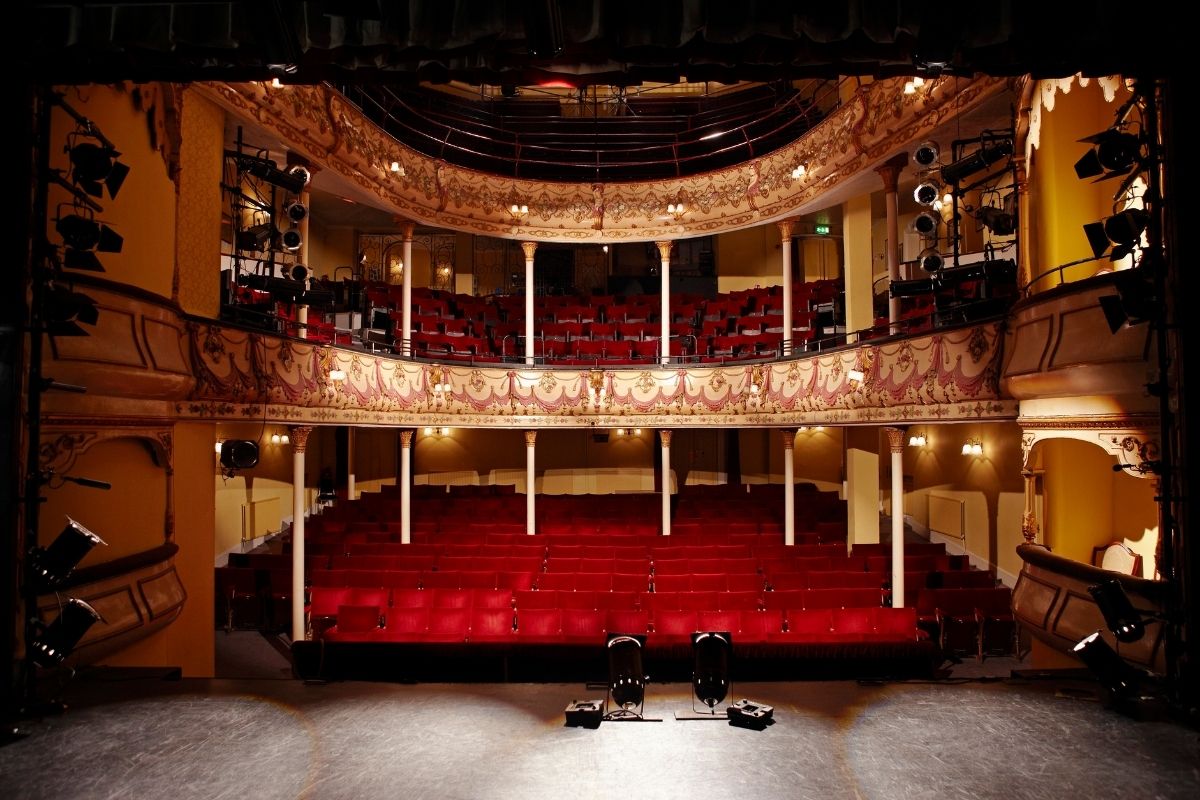
There are many valuable lessons found in online performing arts education. Based on his experience in performing arts, Gianni Downs tells us, “There are three major stage configurations. There is the proscenium stage, which is essentially what you might think of as a theater. A lot of the Broadway houses are proscenium stages. You might see musicals produced on a proscenium stage.” These are set up so that the audience is on one side, and the action is happening on another side, often with a frame around the action. That is the proscenium arch itself. This is a very common type of theater and is very useful for hiding scene changes. Musicals spend a lot of time in proscenium stages.

“A proscenium is an arch,” says Jeff Kaplan, who has years of performing arts education. “Next time that you’re in a theater, look at the shape above the curtain. It makes a picture frame. So, the idea is that you’re looking into a diorama. You’re looking into a world. And traditionally, the performers are inside that world, and you and the audience are on the outside. That forms the fourth wall, but that’s not the only way that you can do it.”

Gianni Downs picks up from there. “Another common theater-type is the 3/4 thrust. You’ll see a lot of regional theaters and off-Broadway theaters will use a 3/4 thrust stage. This is where the action will project into the audience, making a horseshoe shape of the audience. So, the audience sits on 3/4 of the sides of the action of the play.” This is often more used for straight plays or more intimate plays. A very famous 3/4 thrust is the Guthrie Theater, and it might provide a good reference for what that looks like.

Jeff Kaplan then finishes, “There’s theater-in-the-round, which is pretty much what it sounds like. The audience is on all sides, or maybe 3/4. Arena Stage in Baltimore is a very famous example of that.” Circle in the Square in New York is largely a theater-in-the-round. That’s a fascinating experience in which there’s no front where you’re all inside of this world. It’s like a virtual-reality theater.

The Life of a Producer in the Performing Arts

Typically, a producer is somebody who’s leading the ship. When you’re the producer, in many cases, you’re both everyone’s friend and everyone’s enemy. You’re also the person signing their paychecks. Sometimes, you may even be their therapist. Being a producer can look many different ways.

Particularly in the world of the independent theater industry, because the budgets are smaller and it tends to involve renting a space, it’s inevitably going to be a smaller creative team. As a producer, you’ll need people to do a bit more than they expect to be doing, and it’s only because you want to get the show running. Because of this, though, you have to be flexible, and be able to avoid getting stuck in a rigid space.

As a producer, you tend to be the one that everybody looks to. Personally, I have been a part of productions where I haven’t necessarily attended every rehearsal, because I haven’t needed to; there’s a director that was hired, and there’s an entire creative team. However, I’m there at auditions, I’m there at the first rehearsal, and I make myself available.

I don’t find the need to be micromanaging at every rehearsal, though, because I’m not a micromanager. Because I know this about myself, I know I don’t need to attend every one, but I do make a point to let people know that I’m available for whatever comes up. When stuff does happen, it isn’t the time for a meltdown—as the producer, nobody cares about your feelings. You need to fix it. You need to get it going, and make it work.

To learn more about the world of being a producer, both standard performing arts education and online performing arts education can be very beneficial as a starting point.

The Life of a Scenic Designer in the Performing Arts

A scenic designer needs to have several different skills. You can think of a designer as a Jack or Jane of all trades. You have to know a little bit about color theory. You have to know a little bit about how to draw as well as art and architectural history. You have to know how buildings are constructed. These are all things that you can learn on the fly, but it’s a good idea to practice them as you’re starting out. I recommend that everyone aspiring to be a scenic designer take some drawing classes. Doing that alone will help propel you toward a career in theater design more quickly.

One you’ve developed some basic skills, you’re going to need to learn how to draft. You can do so using a pencil or pen, but most people will be using AutoCAD or Vectorworks or some other CAD drafting program. Fortunately, these are technology skills that are actually quite easy to learn. In fact, you might start with a program like SketchUp and import something that you designed there into another program so that you can turn it into a more clear drawing. This way, it will be easier to understand when you give it to others.

You might also need to learn how to paint digitally. Oftentimes, I will choose to work in different programs. For example, I’ll do my drafting in Vectorworks; then, I will do my painting in Photoshop. After that, I’ll combine the two and make a 3-D model with either Vectorworks or SketchUp. From there, I’ll make a walkthrough of my set so that a director and the actors can see what it will look like from various points in the house or even on stage.

I’ve had 3-D models used to sell products. I’ve had 3-D models used in film. I’ve even had to create 3-D models to be used in projection work behind live theater as well. As a theater designer, you never stop learning because technology changes all the time, and your ability to communicate with other people needs to adapt as well.

To learn more about the world of theater design and the performing arts, consider getting started with online performing arts education. This form of performing arts education allows you to gain valuable experience and learn from the comfort of your own home.

The Performing Arts Are a Vital Force for Social Change

One of the questions that always comes up is, “How can I have a sustainable life in the theater?” This is a key question. It is key not only because it allows us as artists to engage in the work that we do, but also because it supports our livelihood.

Sometimes I’ll meet the parent of a young student considering pursuing a performing arts education, and that parent will turn to me and say, “Well, my kid wants to go into theater, but we all know that they’re not going to make any money, and they’re going to starve, and I don’t want them to go through that.” They add, “And we all know theater doesn’t really matter. We all know that it’s just kind of decoration.”

Well, they’re talking to the wrong person, because I go a little bit over the top on this. Number one, the idea that theater doesn’t matter is altogether wrong. It’s just wrong. The theater is not only an important art field because I’m involved in it, and I care about it, so I think it’s important. Actually, history has proven it a vital space for community discourse and for the investigating of ideas in a community.

Further proof is that if you think of any really stringent political dictatorship in the history of the world, one of the first things that they will do is either get rid of all the art forms or try to control them. Trust me — if the performing arts didn’t matter, they would expend no time on even being concerned about them.

But they do matter. They matter because they change history, because they change thought, because they change opinion, because they change our minds and our hearts, and because they bring a community into a conversation. And so, to me, theater is essential. The fundamental idea driving the heart of theater is that artists either will celebrate those beliefs, or integrate those beliefs, and that is what drives our work.

What’s interesting is that when we integrate those beliefs, it actually creates the society’s new beliefs. And that begins to create a cycle of how societies really begin to understand themselves, understand their beliefs, and understand how they function.

So, to me, theater is a vibrant space not only for what really is the sustainability of a community, but also for the health of a community. And that becomes a really, important thing. So there we are — theater is important.

Studying theater is important, too. Your online performing arts education can be the start of an ongoing conversation that leads you to play a role in shaping society’s beliefs.

Online Performing Arts Education on Adapting Material

“I was a great admirer of the novel Curious Incident of the Dog in the Nighttime,” says Elizabeth Bradley. “And at one point, I thought it would be a great idea to teach a course on adaptation. And if I had ever done such a thing, and have not done so yet, I would probably have used that novel as an example of how impossible it actually is to translate the core ethos of a beautifully constructed novel to the stage.”

Well, how wrong could I possibly have been? Because watching Marianne Elliott’s adaptation of Curious Incident in the Nighttime, I sat there and thought, I mean, I’m ready to fall in love with the theater all over again. Because this kind of enlivened theatrical imagination, if you can do this, the theater can do anything. So just when you think, “no,” somebody comes along and says, “yes,” and brilliantly.

It was a different kind of challenge. Of course, that is written in letter form. I think it’s called an epistolary novel. Ta-Nehisi Coates wrote a letter to his son about the reality of living his life as a Black male in America and as a young Black male in America—an important concept in performing arts education.

And the way the adaptation was handled was through a rotating cast of readers, both men and women who tackled sections of the scored book. By scored, I mean the original music composition that was created to accompany the read prose text created another whole piece of emotional access leverage if you will. You felt like you were falling into the words via the music, in a way that you couldn’t really have done sitting at home reading it, no matter how profound that experience was. And I would argue that both have value in the performing arts.

Online Performing Arts Education on Americanizing Theatre

American Theater has this odd attachment to its own mortality. In the 1940s, Arthur Miller was writing plays like All My Sons and Death of a Salesman in America. This was a prime time for American theater. These plays were taking charge across broadway. Arthur Miller made statements about how he wished the theater across the pond in the UK was happy like the theater in America.

Good Theater Never Dies

By the time you get to the 1930s and 1940s, you’re looking at the emergence of Odet’s plays, Arthur Miller’s plays, and Tennessee William’s plays. These were all very popular at the time and still today. Eugene O’Neill appeared twice in the 1910s and 1920s. He then came back after he died in posthumous performances like Long Day’s Journey.

Performing Arts is an Experience that Dates Back to the Early Greeks

What makes American theater great is the sense of sitting around, hearing the stories of your neighbors, all while actually sitting next to your neighbors. This concept goes back to the earliest moment of the Greeks. The most important and magical moment in theater is when you walk through the door. It’s the experience of what you are doing and what you are about to be doing. This represents tracing of the past to the present. It’s something that’s not unlike what the ancient Greeks encountered and experienced back then.

Theater Is a Community Experience

So you walk into this playing area, look around, and see your neighbors. You look on stage and notice familiar faces from the community. You hear stories of adventures that you are going on vicariously through these people. The drama transports you beyond the stage and arena into a world beyond the theater. Together, you are seeing life being portrayed.

Online Performing Arts Education: Analyzing the Script

When you’re analyzing a script, I think you might do well to sort of pick one of those characters and track all those tensions, and then pick two characters and understand how the conflict’s happening. Then pick the family and understand where the conflict’s happening. It’s a show full of a lot of conflict. Characters are in conflict with each other, inside the family and outside the family.

On top of it, the mother decides that she’s going to buy a house. She’s going to buy a house in a white neighborhood. So, everybody has to ask, “What does it mean to, sort of, grow?” But there’s a plant that’s struggling to live, struggling to live in the sun, struggling to live in the sun like a raisin in the sun. Is it going to be the raisin or is it going to grow?

It doesn’t have a lot of sustenance, but it’s got love. It’s got attention. It’s got what the family can give it. So, on some level that’s what the show is about. It’s also about the family to sort of come apart in certain ways, so that they can then come together again. That’s what I think the play is about, and that’s how, as an actor, that’s what I would suggest. If I was scoring it, if I was directing it, I would say, “OK, where do those tensions live? This incident that happens… what is being revealed, and what is being played with, and what is being exposed?” What opportunities do the characters have to transcend where they are, to think of new stuff, to take a chance and to think of something new?

That’s how I would analyze this script, that’s how I would see my way through this—through this artificial thing called a play that happens to be called “Raisin in the Sun.”

[In performing arts,] what human stuff can be brought out? That’s how I would approach the script analysis. I challenge you all to try to uncover that stuff for yourselves.

Online Performing Arts Education: Getting an Agent

“Let’s talk about an agent in the performing arts field,” says Bret Shuford. “If you have an agent and you get an agent — and I will say this — it is much easier to get good work than it is to get a good agent. If your goal is to pursue getting an agent, let that one go. Go for the work. Because if you get good work, you’ll get an agent as a result. If you’re going for the work, that’s going to make getting an agent easy. That’s also going to help your agent. You’re going to build a stronger relationship with your agent because you have a great resume.”

When you’re with an agent, they will send you an appointment. Now it’s all done by email, but I do remember when it was done by phone. And when they send you an email, you want to communicate with them if that time slot works. They will give you a dedicated time slot for you to go in and audition. They will also send you a PDF with the files that you need to prepare. And your job is to prepare as much as possible up until the day that you go in. So that means working with a coach, hiring someone just for an hour to go over those sides, getting a vocal coach if it’s music. And you’ll need to learn that music.

“There are lots of ways to get auditions,” adds Philip Hernandez. “If you have an agent and a manager, then they will be on the hunt for things for you. The breakdowns will go to them, and then they will shuffle off anything they think is appropriate for you. They’ll send it your way. That’s one way.”

There are lots of other ways and lots of self-taping these days. You can go on Actors Access, for instance, and you can have an account there, a profile there. They have a profile for you so that people will be able to look you up. Then, if there are appropriate roles, then you’ll be able to be submitted for those. You’ll get a notification that says you have an audition. Then you do the self-tape, which you do at home, and then you send it in. They’ll give you the sides, the copy, all of that stuff.

Finding representation is one of the things you’ll learn when you get a performing arts education.