Lessons: Introduction to the Production Cycle

Because production is a vital part of the industry, it’s essential to understand the production process and all it entails. The clothes we wear and essentially everything we own is produced somewhere else. All products are sourced, manufactured and distributed.

To work in the clothing industry, you must have a reasonable grasp of what is really involved in the production process-supply chain, the environmental issues, labor issues, quality issues, etc.

It’s important to know and truly understand the customer, including their demands and expectations. You’ll also need to know your price point and how that translates into the various fabric and textile options you offer your customer. You’ll need to know where you’re sourcing materials from and how the products will be manufactured.

Having a good relationship with your manufacturers is critical. There’s a certain degree of trust involved. You’re relying on the manufacturer to execute and deliver your design from across the world. There’s naturally going to be some concerns at first. Will the design be what you requested? Will it work? Will the fabrics used meet the quality and durability standards you demand?

If you don’t get this right, customers won’t come back. If they’re disappointed by the quality, or they’re disappointed by the way the fabric feels, or they think the brand doesn’t embody their values in terms of environmental issues or labor issues, you’re going to have a hard time establishing an on-going relationship with the customers, which is key.

Consumers are holding brands and their designers accountable for understanding environmental issues and sustainability. In the fashion industry, you’re expected to understand the environmental consequences of choosing one fabric over another, the effects of the manufacturing and dyeing process, whether it contributes to water pollution, and more.

You’ll need to know the labor involved in manufacturing, as labor issues can impact the brand identity and the way customers perceive your brand. Customers must feel comfortable with the production process and the values the brand embodies in terms of labor, because as stated before– satisfied, repeat customers are a must for success in this industry.

These are all things that will ultimately impact your brand. In the age of the internet, transparency is everything. There’s little room for error. Thanks to social media, word spreads fast. Customers are quick to “cancel” brands if they’re not producing quality products that align with their values, pose a threat to the environment or misuse laborers. Being ignorant of it, pleading ignorance after the fact, or saying it wasn’t your fault, doesn’t cut it nowadays. Designers and everyone involved in the design industry should ensure they have a really good understanding of all the aforementioned production issues in order to make wise choices.

You have to understand what your choices represent and take responsibility for those choices. On one end, you have to know your customer. You need to know what they can afford, what they want, what they expect and hopefully exceed their expectations. On the other end, at the back end, production sets your price points and also connects to marketing, thus production embodies your brand and your brand’s values.

Ecommerce: Apps and Sites: Activity: Customer Journey

We talk a lot about making customer journey maps. When creating these journey maps, we think about what channels we are operating in—marketing or distribution channels.

So we say, “Let’s design a retail experience travel map.” Then we’ll create another for an entire sale experience where the customer starts in a department store. We might even make a journey map for someone who buys on Instagram. Perhaps we make a journey map that doesn’t necessarily end in a sale. Yet, it could begin with a repair or someone who comes in for a cleaning or an event.

Consider the channels, personas, and touchpoints as you create your journey map. Underneath each of those small touchpoints, write down some of the characteristics you think you’ll be able to capture and identify about that consumer that might be useful for you to market and sell to them.

Make use of any archetype of your choice. When shopping online, consider walking through the consumer journey. A Google search is an excellent place to start. People come across the webpage and visit it. They’re looking through the filters. Consider all of the possible filters that someone would desire. I’d like you to go over each of those processes with me online. Walk through the gaps and consider where you will spend the majority of your time and where you will waste it.

Consider whether they ever make it to the point of purchase. If so, how was your experience? Then give me an overall timeframe because the most crucial factor will be how long it takes our consumer. Are they taking the time to read your blog? Do they pause to read the reviews? Include all of the facts you’ve gathered so far.

Now imagine us moving through a person interacting with an ad on social media, clicking the ad, and seeing where they go, where they land, how they buy, what their feelings are, and what’s going on in their heads.

This is how we choose where we spend our money and what we should prioritize. This exercise will undoubtedly assist you in better understanding your customer journey to choose the most effective route.

From Idea to Business: Building From Product To Collection

Building from a single product to a collection can be a challenge. We’ve seen brands, in particular, that start small. They have one or two silhouettes with a variety of different colorways. They found that one shoe that sticks.

If you look at some of the brands like Yeezy and Allbirds, they’ve come to the table with one or two styles. There is not a plethora of different types of shoes that they’ve come to the table and greeted their consumers with. They have a ton of different colorways. They have also expanded a little bit beyond their original offerings, but at the same time, they’ve had one or two shoes that have carried the day.

All it takes is that one shoe that connects; that Chuck Taylor, that Sperry boat shoe, or one of the Yeezys.

So, trying to create a successful collection, hits at every step of the way, and drives a lot of sales, is often not the model that our companies have. What you can define your company with is maybe one or two types of shoes.

Then, beyond that, you can build out a kind of secondary or supportive offerings that may help drive sales, interest, or meet certain needs of your consumer you’re trying to meet.

However, it’s often that one shoe that drives us and the company to success. We’re able to grow from there.

So, I would focus on one or two things that you do well: One design technique and/or one style; a colorway (or two), or a function that you think is much needed in the footwear marketplace. Then, put all your effort into those areas.

Success will breed the opportunity to expand your line in certain ways, but that just takes time.

From Idea to Business: Business Models

Intro

Watch the full video to learn about:

Turning innovation or research into a profitable business model might not be the first goal. The first goal might be solving the problem. Moving away from Milton Friedman’s idea about companies’ sole purpose being money, to E. Freeman’s theory to focus on the stakeholder, because the stakeholder has a need and an expectation from your brand.

One of my favorite ad campaigns ran before Black Friday. Patagonia released a slogan, “You don’t need this jacket.” They think about the planet, the environment, and start to solve a problem that exists in the consumers’ world, but not necessarily in the product world. Releasing a statement to tell consumers to not buy their product resulted in the bottom line of profit. What it allowed them to do is focus on the things they needed instead of material items or to be different.

This goes back to the better piece. You’re going to experiment and innovate your product. Not everything will work. That’s part of accepting good instead of accepting defeat from trying to achieve perfection.
In the past, we used business models called the fashion life cycle. It was profitable and maintainable because businesses found the decline and the obsolescence and repeated the process. That isn’t feasible in today’s industry.

Today, we need to understand the consumer’s problem, solve the problem with both a strategic and business plan. To build a new business or even think of new ideas is about asking the right questions and gathering the right information, to connect to the right people and services. People don’t have to mean actual humans; it can be AI. It could be a part of our future we need to learn to adapt to.

We speak of technology that will help us to understand how to build new ideas to establish new businesses. You know, back in the day, we would say, I got a million-dollar idea or a billion-dollar idea, today, we have to say, I have a great idea and I’ve sourced it out, and I’ve done my homework. I know there is a consumer audience out there that this idea, this brand, this technology, this service, this product, whatever it might be, will work.

From Idea to Business: Funding Your Business

Many people spend vast amounts of their personal money and don’t realize how much they will need to pay because it’s tough to figure out when to step out of that process. While many businesses worldwide are started this way, there needs to be an understanding of how far you can go with that. It is also wise to line up another source of funding for your business, both for peace of mind and to allow your business and your personal life to have some separation.

Other people are much more savvy about finding funding very early through networking. So, find people, investors, and other founders willing to take on a young brand or project. Do thorough research. Network a lot. Figure out how that works, what the risks are, what the opportunities are, and then make sure that you understand how much of both your own money and external investors’ money you’re going to need to spend in order to get to the level of success that you aspire to.

That’s where having a business mind, a business mentor, and a business partner is critical from day one. Because you don’t want to be in a position where you’re either spending all of your savings to make your dream come true, or you hit success, and you don’t have the financial means to achieve it. In other words, that you can’t meet the demand. So it is highly critical that financing comes into the picture from the get-go and that you are able to scale your financing according to the brand’s success and goals.

How Shoes are Made: Finding Your Inspiration

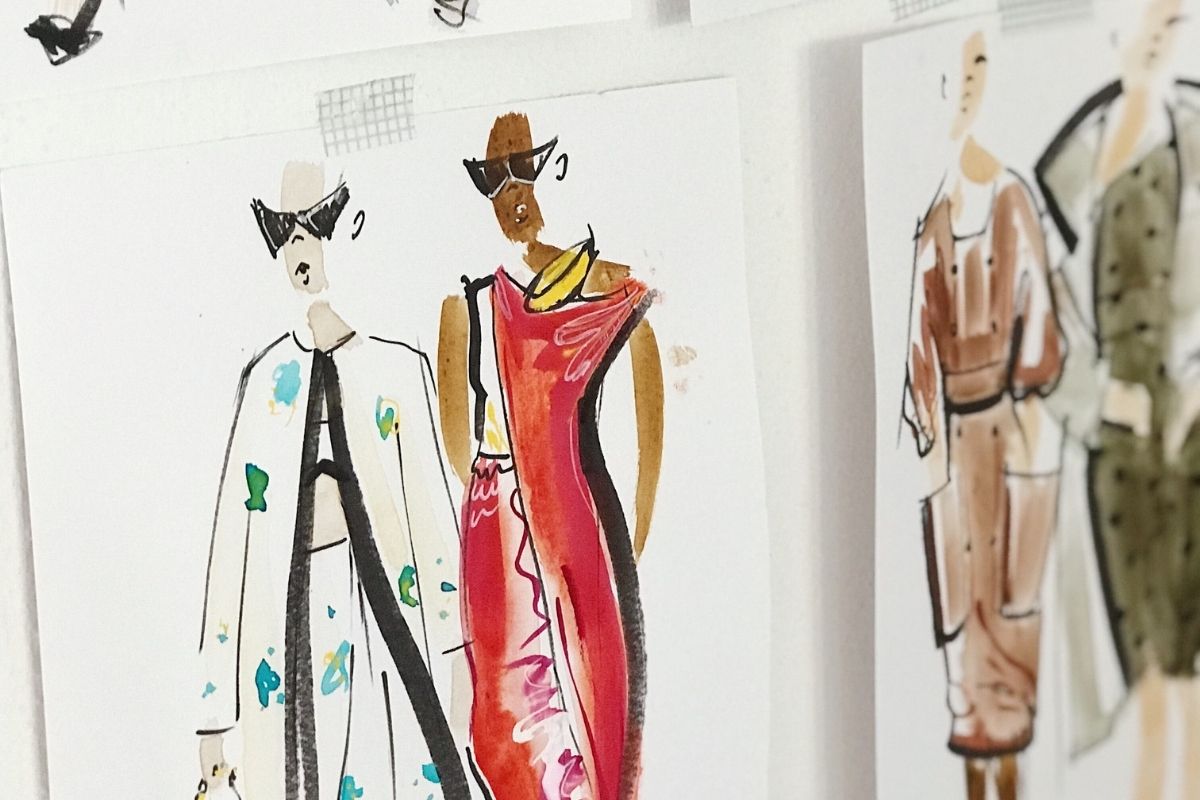
Fashion and footwear collections typically begin with moods, and this is why we call it the “mood board.” A mood board is made by finding inspirational images that fit your mood or theme, cutting out pictures from magazines, newspapers, and physically putting them on a cork board or pinning images on Pinterest. The mood board creates the vision of the collection, whether it’s dramatic and dark or resembles a softer aesthetic.

It will depend on the season as well as who you’re targeting in the footwear business. Who’s the target audience? Creating your footwear collection requires both creativity but also practical online footwear education on seasonal trends, forecasting, and catering to your goal customer and retail stores.

You’ll want to know what’s happening in retail stores simultaneously. Visit stores, such as Saks Fifth Avenue and Bergdorf Goodman, to observe and see which colors and details resonate for your own collection. What fabrics and embellishments strike a chord? You may see something at the back counter, or a small detail on a bag, or even the woman walking on the escalator captures your mood. Inspiration can be found at every turn.

The footwear education and design process is important for everyone to know, not just the designers. The process to get there needs to be, and is, touched by all different people throughout the shoe company. It includes the research of color, material, trends, design ideation, and the editing process to get to the best design.

Making shoes requires an extensive product development period where you’re not only working to resource your materials, prototype, and sample, but you’re getting the fit right. All of this needs to be done in a timely manner. This all happens before any pre-production or production and many people touch and influence the design process from marketing to customer, designer, and executives.

How Shoes are Made: Identifying Your Consumer

A customer profile is extremely important because if you’re trying to sell to everyone, you won’t sell to anyone because you’ll be too spread apart. You have to have a focal point on the kind of customer you want to go after because after you grow, your customer profile will grow, and you will gain others. You have to have that strong focal point in the beginning of what’s the customer you envision wearing your brand or wearing your shoes. One customer profile is a sexy, sassy woman or man that loves wearing stiletto heels.

When identifying a customer for your product, it’s important to know who your customer is, but also what is your product and service? After identifying what your product or service is, you’ll be in a better place to identify who your customer is. Start customer identification through demographics. What is their income? What is their location? What do they do for a living? What is their age? What is their ethnicity?

There are cultural nuances that influence a customer’s buying decisions as well. To further that customer selection, it’s also important to know customer psychographics. What are their hobbies? What do they enjoy doing in their free time? What are their favorite colors? What is their personality?

A lot of times this research is readily available, and you can search past footwear outlets or resources to find that information. Another great way to find this information is through social media. You can maybe hold a small focus group. You could reach out to your friends and family to get their insights.

If there are different groups on different social media platforms, whether those are sneaker lovers, leather shoe lovers or Timberland lovers, you can reach out to these groups to really tap into finding out what it is that they look for in their footwear selection.

If that is your customer, that is a great way for you to identify them. Talk to them and get inside their mind. What are their hobbies? What do they like to do? Are they the ones who are going to be purchasing your shoe? If not, then maybe you need to direct and find someone else. When you are doing the research to identify your customer, keep these things in mind: demographics, psychographics, and everything else will fall into place.

Instructing the Manufacturer: The Tech Pack: Case Study: Clo3D

CLO 3D is bringing the technical aspects of fashion design under one program.
The first thing we need to understand about the program is how it handles measurements. Measurements aren’t universal, so the first step is always working out, for example, what a size six means for your company. What are those measurements?
Those measurements are built into the CLO system, but what does this mean? Well, when you’re designing on your avatar, you have that size six. You have the sleeve length and all the measurements you need to design a pattern around that size. Not only do you have the measurements, but you also have the grading – all that information can be put into the program.
The technology allows you to print out the pattern based on the information you input. This includes the styling, the measurements, and all the details. It’s a fantastic way to build a garment from the ground up, ensuring internal consistency between all your designers and the products they create.
As with any modeling technology, there is an initial learning curve, especially for designers who tend to work with traditional mediums. Still, design students tend to pick it up quickly within the semester, with many of them building their own garments using the technology.
It may take a while to understand, but it’s not needlessly complicated. Everything has a function. For example, you don’t need to understand flat pattern making. Of course, having a background in traditional design is beneficial. You’ll need to have some background in sewing and how pieces come together to make the most of the technology.
As with any aspect of design, it takes time to master. Still, it’s a great tool, especially for students who are working online from home right now. Online you can learn the computer technology aspect well and start playing with the system. You can create your avatar and start designing as someone interested in the program.

Instructing the Manufacturer: The Tech Pack: Sampling and Tech Packs

When fashion designers need to instruct manufacturers how to create their products, they communicate the specifics by creating a tech pack. These documents explain all the information required to transform an idea, drawing, flat pattern, swatch selection, or combination of such concept elements into a finished garment.

After creating a tech pack, a designer typically forwards it to their product development, or PD, team. The PD team then sends the information to a factory – or multiple factories. This strategy reveals which factories can meet the desired standards and which are the most cost-effective. According to experts, cost differences are common, so it’s vital to aim for the highest quality at the lowest price.

Eventually, the factory returns samples based on the tech pack specifications. At this point, the designer evaluates the results based on various criteria. One common consideration is whether the factory produced an item to the stated specifications. In many cases, the quick turnaround times involved at this stage will result in some variability. For instance, early samples may incorporate substitute materials since a factory won’t have had time to prepare for the new specification in advance. Nonetheless, designers and their merchandising teams can benefit from considering whether the garments are aesthetically pleasing or correctly fitted.

Designers commonly have seemingly great ideas that don’t quite translate into appealing real-life apparel. In most cases, however, they prefer not to deviate too far from their initial tech pack specifications. Sticking to the plan helps brands satisfy tight timeline constraints.

Many production teams operate around something called a “Time and Action Calendar.” This well-known industry schedule involves a heavy, continuous workload. For instance, companies may work on three seasons’ worth of collections simultaneously, each with its own tech packs. Further complicating the timetable, a typical tech pack can progress through a cycle of multiple sample runs before being ready to go to market. In other words, it’s best to keep the initial tech pack as close to the desired target as possible.

Lessons: Design School Collections

“What inspired these young designers started almost a year ago with sketches, inspiration, and research,” Explains Explains Francesca Sammaritano. “The end product is what you see over here. You’re only seeing one look per designer. But, I wanted to share that with you.”

“It gives you a wide range of specializations that you can go into within the fashion industry, whether it be men’s wear, outerwear, women’s wear, or a more designer-level collection or aesthetic that you want to pursue.”

One designer did a collection of women’s wear outerwear with a lot of in-depth research on how outerwear works, what kind of technical fabrics you need, what colors work best, water repellency, all kinds of removable liners for when it’s cold or when it’s raining while also giving the option to wear the garment in different ways.

If you zip out the liner, you can wear the liner as a vest. She went a step further. She had a collection of shoes and boots made to go with her collection. The design process is inclusive of accessories as well as garments. She will pursue an opportunity in outerwear.

Another example of the variety of jobs or opportunities that you can pursue once you become a designer could be women’s wear designer on a higher level. This designer really values the art of craft. He invested in a weaving machine. He made this fabric. He bought the yarns.

He designed the fabric, made yardage, and then he sewed the garment. He is now pursuing an opportunity in designer women’s wear with a focus on craft. Another example that I thought would be wonderful to show is our menswear designer who coincidentally won the Menswear Designer of the Year.

This is just one example of his extensive collection. In this, he incorporated a few different aspects. He used natural fibers. He printed his own fabric and his own print from curtains that inspired him from growing up in his house in childhood. He is a menswear designer.

But, we found that in the conversations that we had with him and in the presentations that he’s had of his collection, a lot of people would ask him, would you consider designing for women’s wear too? Because as a woman, I would wear your garments. Or you could do both. Or there could be a customer for either/or. This is a very interesting, trendy category that we find a lot of students are going for.