Tracing the History of Performing Arts to the Present Day

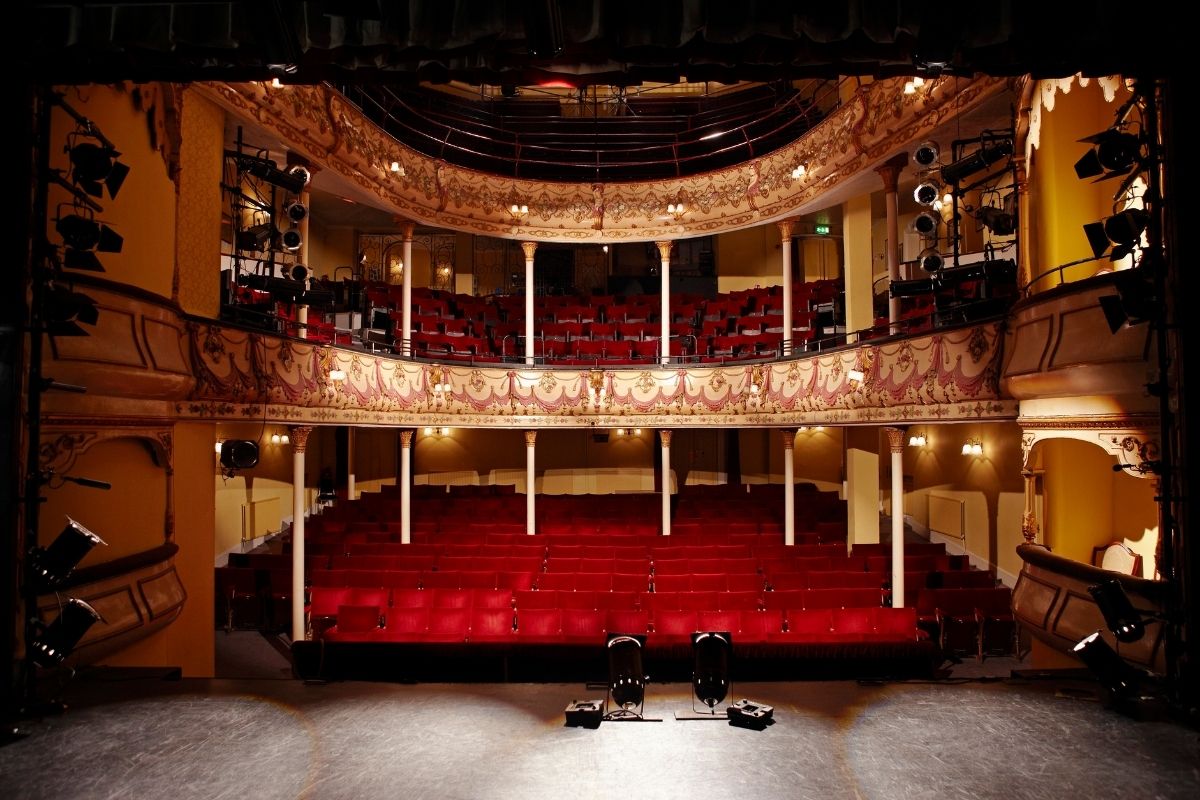
The most common form of theater across time and space has been solo performance. Think of a storyteller going into a public space, often accompanying themselves with music or speaking in poetry. These performers go by different names: bard, rhapsode, skald. In some ways, a rap artist is a direct inheritor of that tradition.

But Jeff Kaplan says, “When we think of a play in a theater with the lights off and a curtain and we applaud at the end, that form really begins in the 19th century.”

That might sound strange, but it’s true. Kaplan points to the year 1876 as an important turning point in performing arts education. In that year, the German composer Richard Wagner built an opera house in Bayreuth, Germany. In that opera house, the audience all sat facing the stage.

That was different from anything previously known. Before, the lights would be on, and the upper class would sit on the sides facing each other. They wanted to see what each other looked like. The middle class would sit in the middle, and the lower class would sit up in the high areas and throw things and yell and scream.

It was very raucous. It was very much a social event. Kaplan elaborates, “This modern notion in which we’re all sitting very quietly, and we’ve all purchased a ticket so we can consume the content, you know, that’s actually pretty recent.”

As you move through a European idea of theater, you’ll come to Shakespeare the verse plays. Next in online performing arts education, you’ll move on through the 19th century and the creation of naturalism and realism. Of those styles, Elizabeth Bradley explains, “We’re meant to actually suspend disbelief and feel that lives we can relate to are being reflected on stages.”

Realism and naturalism are terms that are often put together, conflated or used interchangeably. Bradley uses a recent important revival of “Our Town” — considered by many an iconic American play — as an example.

Of that particular production, she says, “Using all of our senses as an audience was important. So actual bacon was frying on stage in an actual frying pan in real time. And that’s an example of a kind of heightened realism.”

We still have the (David) Belasco Theatre on Broadway. In the very early years of the 20th century, David Belasco was a producer who believed that every detail added to a certain sense of verisimilitude, the sense that it is real, that it is truthful. Bradley shares, “So every afternoon, he would bring in real shanks of meat to hang on the stage, and they would ripen, so to speak, under the lights during the productions.”

Kaplan says, “Another date I’d point to is 1879, [when] a playwright named Henrik Ibsen wrote a play about a woman named Nora who is in an unhappy marriage.” As viewers watch the play, they discover that Nora has a secret. They also learn that there’s not really a bad guy; there’s not really a villain.

He continues, “And in the end, she walks out — spoiler alert, I’m sorry — but she walks out [on] her family on Christmas at night in Norway without a coat, and she slams the door. And it was the door; it was the door slam heard around the world. Women just didn’t do that.”

With that, theater had spoken truth to power forever. Shakespeare’s Hamlet says that theater is a mirror held up to nature. That’s the beginning of theater’s relationship with modern identity politics. Ever since, plays have really gone where things are sticky.

Take Lorraine Hansberry’s “A Raisin in the Sun,” for example. It’s about the American dream. “After World War II, who can dream?” Kaplan asks. “Does that include an African-American family living on the South Side of Chicago who wants to buy a house in the suburbs? Are they allowed to dream?”

And so, ever since then, performing arts has addressed key issues that confront us to this day and, in fact, right now.

Understanding the Playwriting Process in the Performing Arts

In the process of writing a play, Robert Galinsky states, “I’ve discovered there’s not one right way to do it.” There are many different ways to produce a successful stage story in the performing arts. One of the plays I was writing utilized the advice of Robert McKee, an incredible story structure artist. His main tip is this: Writing is rewriting, is rewriting, is rewriting. The willingness to review and revise your playscript is the key to optimizing your story. Reading McKee’s books and articles is the first step to a performing arts education.

Focusing on the story is one of the most effective ways to write plays. Galinsky recommends that writers should “write the story. Rewrite the story. Rewrite the story again and rewrite it some more. Don’t be afraid to honestly appraise the story, and be willing to eliminate weak plot points or write better ones.”

Every time your characters want to speak, don’t let them. If a brilliant line comes to mind, jot it down. But don’t start writing with dialogue. Start writing with the story and develop a plot.

When your story is really cooked, and you love it, now, open the door and let the characters start talking. They’re dying to speak. They will know what to say because the story is so strong.

That’s one way to do it. But another way to write your play is if you know the characters so well that you can let them go ahead and speak. Galinsky says, “I put them in a room on a piece of paper, and I get them to start talking. I will create an outline while they’re talking, and they help me discover where we are going with this conversation.”

Don’t think there’s a right way or a wrong way to write a play. There are many different ways that depend on where you’re at in your life and what you’re interested in and excited about. Robert Galinsky loves writing the story, story, story until they’re ready to speak. But, he also knows “the five characters inside and out, so I’m going to let them start talking and keep talking.”

All of a sudden some gems of lines can come up, and they’re driving the plot. That’s exciting, too, because when you’re an audience watching a story-driven performance in the theater, it’s different than film. Because the performance is story-driven in the theater, it’s great when the characters take a twist or turn that you don’t expect. And many times, that is only going to happen because of the characters’ response with dialogue, not necessarily their thinking about where the story should go. Watching a play can be an online performing arts education if you are aware of these drama elements.

Understanding the Relevance of Theater in Performing Arts

It’s important for me to look at theater as a field. Yes, a part of that is the industry, which can be very exciting. There’s so much more to explore. Theater doesn’t simply involve a kind of making of a show for a particular audience in a particular theater. It can mean many things. This is an essential element to teach in any performing arts education, even in online performing arts education.

“It happens in small communities, in large communities. It happens with professionally trained individuals, also within community members. It happens in spaces that are, again, about the texts, others that are physical. It takes on all these forms. In many ways, the exploration of theater is an ongoing thing that will keep changing, growing, and developing,” says Ruben Polendo.

You must see theater as a field, for those in theater or who have an interest in theater. The exciting thing is that you have an agency to navigate that field as a theater artist. Regardless, we all navigate the field differently.

“Theater has this odd reputation, which I want to dispel. I want to just push that away. That reputation is one in which people imagine being for this rarefied few. That you go there and everyone’s wearing a tuxedo. They’re watching whatever is playing with opera glasses. It’s just the most alienating, foreign not-for-us scene out there,” states Harvey Young.

That’s not the case at all. Theater, from its roots, has been about people coming together to watch performances. It began as street festivals, street fairs. Think of your favorites as an outdoor concert where people gather, and the community is there. People are expressing their delight, their pleasure. That’s the kind of energy that theater strives to capture. To put into a building and invite people.

That’s the core, base, the root. If you think about what theater gives you, the theater provides that chance to be a fly on the wall. It gives you a chance to spy, to listen, to encounter the stories, the experience, the lives of people who are not your own. It’s a bit voyeuristic. That’s part of the pleasure of it too.

It’s like you are getting access to stories and experiences you haven’t seen before. In some cases, if it’s musical theater, you’re watching not only those “fly-on-the-wall experiences.” You’re also encountering true virtuosity. You’re watching Lin-Manuel Miranda freestyle in certain moments. For example, In Love Supreme.

Theater creates proximity. You’re in the same room as the actors. You’re breathing the same air, and you’re in the seeing moment. It’s not like TV. It’s not like the movie theater; you are there. Your interaction, physicality, and coughing can change the spirit, dynamic, and mood of what’s taking place. That’s why people love theater so much. It feels different when you are there.

Using Performing Arts Education to Understand One Another

Walter, at some point in the show gets a check from his mother because she’s like, “I have to support him, He’s a man, he need to feel like a man.” She gives him the check and the friends that he was thinking were going to hook him up, steal the money. They’re gone so then the family has to make a decision. Meanwhile, the homeowner association in this neighborhood where the new house is, sort of, come late to the table to understand it’s a black family and they want no parts of that. They send a representative to come basically buy out the family to give them a check to not move into the neighborhood and so this is also playing itself out.

By the end of the show, they dismiss him and they’re all back together as a family. They’re back as a place that can contain all these tensions that we have watched play themselves out with each individual character who has a collection of traits and a way that they walk through the world. We also see a way that they think about the world and a way that they relate to people, which is in many ways different than any other character. Then the question comes, “They’re all one family, so at what point do they have the connection and where is the connection?”

That’s what I think the play is about and that’s how you sort of as an actor say, “Where do those sort of live?” I would suggest that, even if I was scoring it or if I was musically directing it. In this incident that happens, what is being revealed and what is being played with? What is being exposed? What opportunities do the characters have to transcend where they are, to think new stuff, to take a chance and to think something new? I think that would be an important way to sort of think about it. That’s how I would analyze the script. That’s how I would see my way through this artificial thing called a play, that happens to be called Raisin in the Sun. Online performing arts education suggests asking, what human stuff can be brought out that anyone in the audience can relate to? Because everybody comes from a family, whether they are inside of that family or outside of it. Everybody sort of has a location. Everybody has a way of thinking about the world and moving through the world, which is uniquely theirs. Performing arts have a way of connecting everyone, no matter the background.

The question for all of us is, how do we live together? How do we connect together? How do we connect as a family? What binds us, and then how do we overcome the obstacles that come to us? Do we do that in separate ways, or do we need to come together to do that? That’s one way of sort of approaching a script analysis on this play that I think could be really useful because you see a whole lot of stuff. Then the trick is, where do you see yourself?

“Do you know what this money means to me?” says Walter Lee Younger. Do you know what this money could do for us, mama? Mama, I want so many things.

Lena Younger replies, “Yes, child.”

Walter Lee Younger then says, “I want so many things that they’re driving me kind of crazy.”

What Are the Benefits of Cross-Promotion in Performing Arts?

One thing you can do in the theater world is to raise money for another organization. That might sound counterintuitive to anyone in performing arts education. Why would you do that? According to Malini Singh McDonald, it can be easy to miss the benefits of cross-promotion and raising money at an event.

Speaking from her own experience, McDonald explains, “We did a one-night event, and it was for the LGBT Center. And what we did was my friend — and actually my conspirator — he had a play that he just wanted to get up and heard.” The two worked together on a reading of the play and created some price points around it.

McDonald continues, “I love a raffle because I can sell raffle tickets. You want me there at your matinee performance doing that. But that is also key because people will spend money on that.”

At that one-night reading, her performing arts team was able to raise money through raffles for another organization. As McDonald puts it, “So now this other organization knows that there’s this play out there, and you use all of that in your marketing materials.”

Robert Galinsky offers similar advice for anyone in online performing arts education. He recommends, “When you’re putting up a production, you’ve got to align yourself with lots of different people, lots of different organizations. I discovered this when I was in Hollywood.”

Galinsky talks about a time when he was putting on a show and doing everything he could to get people in the seats. The show was packed every night until the end of the run.

The plan was to do another run, but he couldn’t imagine putting the energy into getting people into those seats again: “That’s all I spent my time doing [was] driving an audience to the show.”

Instead, he decided to adapt. “I called every organization in LA that deals with homeless people,” he shares, “and said, ‘Let’s do a pop-up benefit show for your staff, your audience and your clients.’ And every one of them responded positively.” Galinsky received feedback like, “Oh my gosh, yes,” and, “That’s a great idea.”

When he started to do his show, he didn’t go through the normal theater channels. Instead, he used the organizations’ audience base. Those people were interested in the subject matter. They wanted to see the show, so it was a perfect fit.

Before taking his show to LA, Galinsky spent months ahead of time researching all of the organizations that served people experiencing homelessness. Once he set dates for his theater, he sent the organizations carte-blanche invitations. Their entire staff and anyone they wanted to invite would get free seats. He explains, “You work hard; you work with this population. I want you guys to have a treat. Come in, see my show for free, and give tickets away to your volunteers, your staff, whomever.”

During this time, Galinsky had an agreement with his investor. They knew that they weren’t going to make their money back on ticket sales, so the investor was fine with papering the house and loading up seats.

Every single night, at least four organizations that served people experiencing homelessness were present at the show. Beforehand, Galinsky told each one that they could have 30 seconds during the talkback at the end of the performance to pitch their organizations. They could tell the audience who they were, what they did and whom they served.

As Galinsky recalls, those organizations packed the seats. To sum up the experience, he reflects, “The thing you have to remember now is I put my butt on the line here, because if the material wasn’t authentic, if the material wasn’t real, I had people who deal with homeless people every single day watching this. They would have been disgusted with what I was doing. Thankfully, the work was good. The work was solid. And they would come up to me and go, ‘I saw my client today. I saw two of my clients on stage. I deal with that guy every day. The one who was begging for cigarettes, I see him every day.'”

What Rights Do Playwrights Have in Performing Arts?

The Dramatists Guild is a wonderful organization that supports playwrights all around the world and protects their rights. I would suggest joining the Dramatists Guild to anyone seriously trying to work in playwriting. Anyone in performing arts education can join it.

It wasn’t always like this. Playwrights didn’t always have such protections. Arthur Miller used to tell a story about how he went to the offices of a Broadway producer, and the producer had all of these books on his shelf that he had co-authored. Miller said to the producer, “Oh, I didn’t know you were a writer, too.”

The producer said, “Oh, I’m not. I just buy the copyright from these authors, and then I put my name on it as co-author.”

Thanks to changes in copyright law, that doesn’t happen anymore. And thanks to the Dramatists Guild, there is enforcement around these kinds of things.

When you write a play, a theater or a producer can license it from you, but they don’t buy it outright. They don’t own it. They can’t make themselves the co-author. They are paying you for the use of your work. You still own the copyright.

The Dramatists Guild has what they call the Dramatists Guild Bill of Rights. It says that the playwright has the right to be involved. It also asserts that unauthorized changes cannot be made to a script without the playwright’s permission.

A lot of people in online performing arts education don’t know that. They may have grown up with drama teachers doing cuttings of things. The teacher might take out a word or a scene that’s inappropriate for young people, and they think that’s totally legitimate. It really isn’t, and playwrights are allowed to — and have — shut down productions that have deviated from the script and made changes that nobody asked their permission for.

Sometimes the changes are really big, like changing the gender of a character. Other times, it’s just a word, and sometimes the playwright doesn’t care as much or finds out about it later.

But, in general, if you’re putting on a play, it is in your absolute best interest to check with the playwright before you make any change, no matter how small. Otherwise, the writer does have the right to shut down your play. Also, of course, you should always begin by getting permission to do the play.

A lot of people in performing arts don’t know that, and a lot of places have been shut down.

Why Diversity Matters in the Performing Arts

Many times, acting from an objective, external perspective seems simply like role pretending or mimicking other people. It’s easy to focus on the distance between you and the role. But in truth, being an actor is really about finding a way to reveal yourself through a given role in a screen or stage production.

For too long, acting meant one thing, or the kinds of acting, the kinds of stories, that were being told were only one kind of story. It’s vitally important at this moment, and it’s late in coming, that we find ourselves really encouraging newcomers to find their voice as an actor in the performing arts. It’s important to understand the way your own experiences, your unique point of view, and your individual identity offer something to your playing a role. It isn’t about you ignoring who you are or your story but bringing your perspective and experiences to the part. A quality performing arts education can help you to appreciate the challenges and opportunities of putting yourself into each role.

Your work is important and valued if you bring yourself fully to it and are given permission to do that. The more you are enabled to bring yourself to a role, the more your voice as an actor will be understood and heard. Nothing could be better for the profession or for you as an artist.

For too long, the stories that have been told in the theater, in TV, and in film have been the stories of white Europeans and particularly white European men. Those were the writers whose stories were produced. Here in the United States, it was white people and white men whose stories and plays were told and who were hired for the acting jobs.

Currently, we’re at an important moment of transition where Black artists, persons of color, and indigenous artists are finally, after far too long, being recognized as the vital storytellers they have always been. It’s important to them, as we encourage greater inclusion and people to bring their own identities into their work, that we recognize a unique voice is part of what needs to be valued in the performing arts process. It’s not enough to bring diverse voices into a room. Those voices have to be valued and their stories need to be told. Coming along with that can’t be a request for someone to set aside personal experiences or an untraditional point of view in order to transform into something else.

As you explore your work as an actor, what’s really important is that you give yourself permission to look at a role. Even when you see distance from it, recognize and really believe that your experience, your identity, your point of view, and your history are vital for the way you are going to be able to tell the story in a unique and meaningful way. You can study this process further by pursuing an online performing arts education. Learning all you can about inclusion and diversity in the performing arts will prepare you to make your mark in the industry.

The Performing Arts Are a Vital Force for Social Change

One of the questions that always comes up is, “How can I have a sustainable life in the theater?” This is a key question. It is key not only because it allows us as artists to engage in the work that we do, but also because it supports our livelihood.

Sometimes I’ll meet the parent of a young student considering pursuing a performing arts education, and that parent will turn to me and say, “Well, my kid wants to go into theater, but we all know that they’re not going to make any money, and they’re going to starve, and I don’t want them to go through that.” They add, “And we all know theater doesn’t really matter. We all know that it’s just kind of decoration.”

Well, they’re talking to the wrong person, because I go a little bit over the top on this. Number one, the idea that theater doesn’t matter is altogether wrong. It’s just wrong. The theater is not only an important art field because I’m involved in it, and I care about it, so I think it’s important. Actually, history has proven it a vital space for community discourse and for the investigating of ideas in a community.

Further proof is that if you think of any really stringent political dictatorship in the history of the world, one of the first things that they will do is either get rid of all the art forms or try to control them. Trust me — if the performing arts didn’t matter, they would expend no time on even being concerned about them.

But they do matter. They matter because they change history, because they change thought, because they change opinion, because they change our minds and our hearts, and because they bring a community into a conversation. And so, to me, theater is essential. The fundamental idea driving the heart of theater is that artists either will celebrate those beliefs, or integrate those beliefs, and that is what drives our work.

What’s interesting is that when we integrate those beliefs, it actually creates the society’s new beliefs. And that begins to create a cycle of how societies really begin to understand themselves, understand their beliefs, and understand how they function.

So, to me, theater is a vibrant space not only for what really is the sustainability of a community, but also for the health of a community. And that becomes a really, important thing. So there we are — theater is important.

Studying theater is important, too. Your online performing arts education can be the start of an ongoing conversation that leads you to play a role in shaping society’s beliefs.

Prepare for a New Role and Succeed in the Performing Arts

I do a lot of research about the time and the place when I start a new piece of material or undertake a new character. I feel so lucky that I live close to the Met because I can go and look at paintings. Especially with “Hamilton,” I can see paintings from that time, see how they make me feel. I can feel what women are saying within those paintings, within those portraits, because that’s all we have from that time. The research process is half online performing arts education and half real-world experiences and feelings applied to your character.

I try to look as much as I can to people that know more than me about the time period, about all of the facts, to get to the truth. Then, I have to really look into myself and see what my subtext is. What is underneath all of those facts? Is there an accent? Where is she from? When was she born? What’s underneath all of those things?

Sometimes a character can be very relatable to my own life, like Nina Rosario. I felt so connected to that character, because I’m the first one in my family to go to college. I always did things not just for myself, but with the notion that I was doing something more for my family and my community. That was a big part of my upbringing.

Nina was so much like that, and she took a lot of the weight of the world on her shoulders. I understood where she was coming from. I knew what her intention was, and I knew what her truth was, because it was just part of me. So, I had to bring that to the performance, which can be the hardest part, being vulnerable, being open to whatever’s going to happen.

I’m not robotic. I like to go in and breathe with the other actors and see where they are that night and what they’re giving me, and see how that moves me, how that moves my character, and see what I give them back. You can learn a lot from a performing arts education and also learn a lot from your fellow actors and their processes and performances.

It’s a very organic feeling every night, and I love that. I wouldn’t want it any other way. When you have an acting partner that also works that way, it’s just magic. The basic way that I try to build a character is really from the ground up and through honesty and through my truth.

The Role of Blocking in the Performing Arts

Back a long time ago, the idea of blocking was pretty straightforward. It was really about stage picture. You stand there. Or I stand here. Or you sit on this line. Or I stand on this line. There are moments when making specific movements across the stage or movements on the set are prescribed in a precise way that we need you to do this now because of something that happens in the script.

But the truth is that much of what happens in blocking is a collaboration between actor and director. It is the exploration of the actor’s actions and needs in a given moment in a scene. It’s easy to take for granted something as simple as walking across a room or where you stand in a space. But the following simple examples may help you understand how meaningful blocking can be in the performing arts.

So, if you picture a fairly traditional theater with the audience on one side and the stage on the other, you can then imagine an actor standing in the middle of that space, facing the audience, in a stance that means something, right? This person is alone. Depending on how big the space is, we experience something about the scale of a human being in this space. We might think about how that person is or isn’t like us as an audience member.

Now, turn that person away from you so that they’re facing away. That’s right; they’re facing upstage. Suddenly, I lose all sorts of information. I can’t see that person’s face or expressions. As an audience member, I’ve lost information, but I’ve gained potential interest. You might not be aware of these perceptions unless you have a performing arts education.

Now, what if that person extends their arms really wide, opens their chest up, but I can’t see their face? You can imagine that any one of those choices makes a big difference to how we experience whatever that person says in that moment. But it can be challenging to interpret that person’s stance, movements, and gestures without the help of facial expressions.

It becomes even more exciting and complicated when you have multiple characters onstage. If I have two actors very far downstage, very close to the audience, huddled together, whispering to each other, my experience as an audience member is going to be one of tremendous intimacy.

But if I keep one of those actors very close and send another far away upstage, it’s going to change my relationship with one of them with whom I have a much closer, intimate relationship to that other person who is much further away. I might begin to have an empathic response to the person who’s closer compared to the one who’s more distant.

As an actor, it’s valuable to understand that your audience is experiencing, particularly in theater, your work as a kind of three-dimensional sculpture that’s constantly changing shape. As a director, it’s important to understand that everywhere that bodies are in space communicates something to your audience, as you might learn from an online performing arts education. So, it’s better for that communication to be intentional rather than accidental.