Costing the Product: Material Costs and Markups

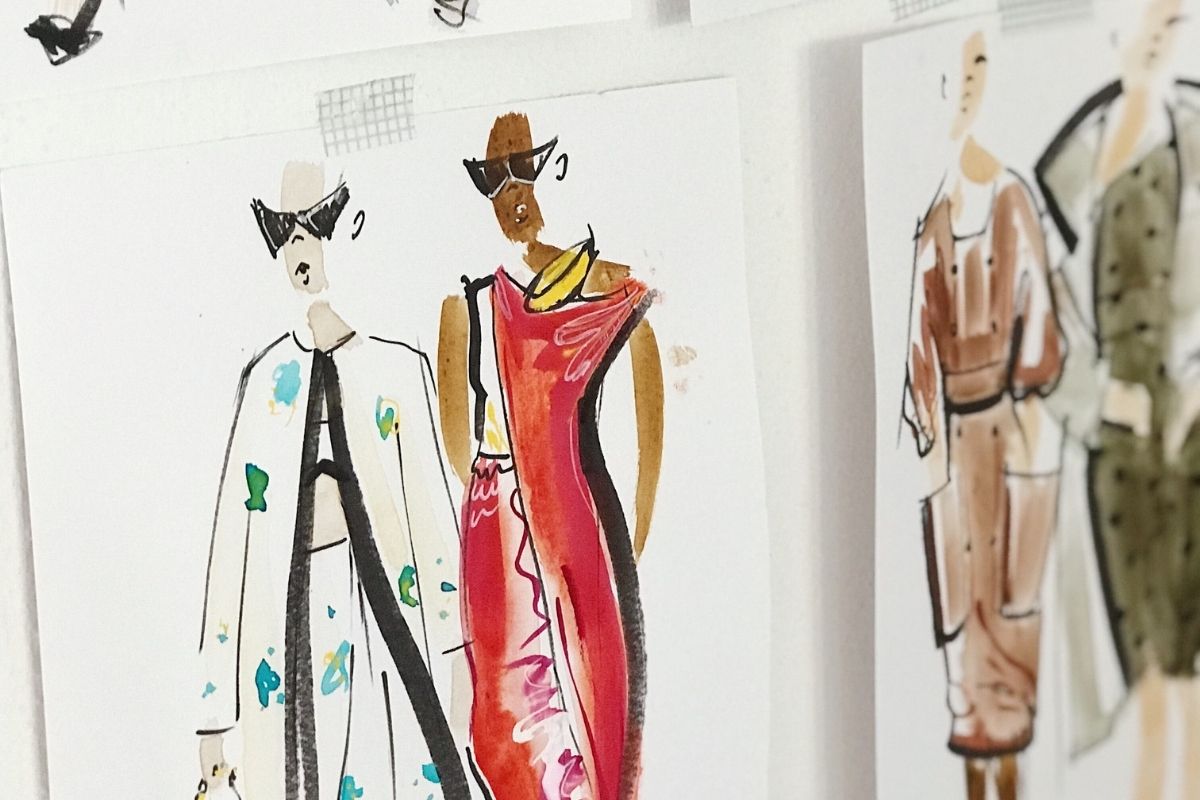
Costing your fashion product usually involves a few components. As a merchandiser, you may have 10 styles and want to have a certain markup. If you’re selling within your own stores, you usually want at least a 75 to 85 percent internal markup. If you want to retail a jacket for $695, you need to then back it up and already know that your landed cost needs to be 20 percent of that to get your 80 percent markup.

If the coat designer wants beautiful satin made in Italy, your cost of goods will increase. Generally, when you’re looking at cost of goods and cost on the item, around 70 percent is the raw materials. In your fashion business, you must think about the actual materials – the thread, the trim, the buttons.

If you are going to get your desired 75 or 80 percent margin, this coat is going to be $1,500 versus the $695 you wanted. You’ll then have to go back to the design team since the market and your brand can’t retail this high. The cost value is not there, so you’re going to see where you can cut costs using fashion education and sourcing. Can you counter source a material in another country that looks and feels the same? Can you take a few pockets off to lower the cost?

The second component of costing is having a loss leader. A loss leader is the one item that’s the showstopper, the most fashionable piece. You need this piece to draw interest to the collection, although you’re getting a lower margin, possibly a 40 to 50 percent margin. You’re going to make fewer units, but the other styles have higher margins. Many fashion brands use this blended costing because ultimately it’s the blended total that makes a difference.
Costing the Product: The Costing Process

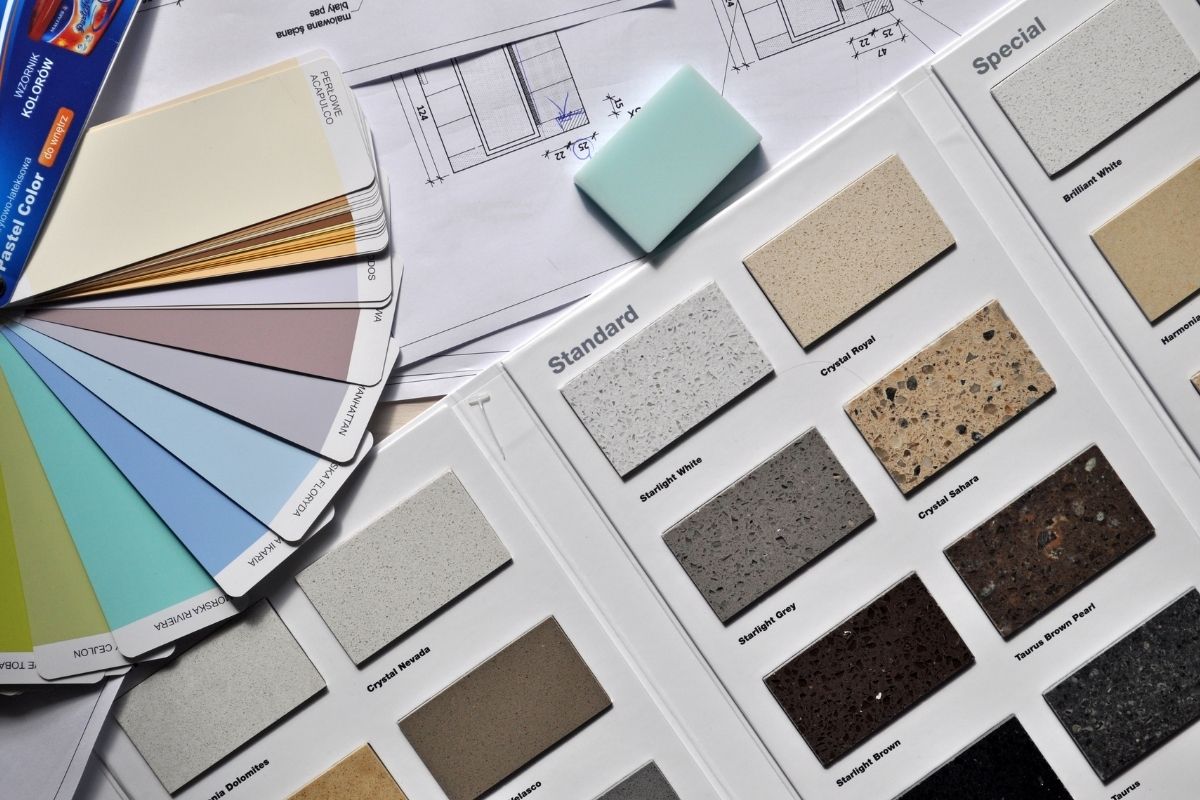
Costing a product is a full-time job and usually takes many people. You can look at costing in a couple of different ways. As a merchandiser, let’s say you had 10 styles, and we wanted to have a certain markup. If you’re selling within your own stores, you usually want at least a 75% to 85% internal markup. If you want to retail a jacket for $695, and you already know that your landed cost needs to be 20% of that to get your 80% markup.
A designer wants this beautiful satin made in Italy. When you’re looking at the cost of goods, around 70% is the raw materials, like the thread, the trim, and the zipper or button. A designer goes to Premiere Vision and finds the most beautiful Italian satin they want to use. If you are going to get the 75% or 80% margin you want, the jacket is going to be $1500 compared to the $695 or the $595 you wanted.
You go back to the design team and tell them that if the market can’t retail nor our brand can retail a jacket this high, there’s no the cost value is not there. Start taking things out of it. Can we counter source material in another country that looks and feels the same but not the higher quality? Can we take a few pockets off of it to lower the cost?
Let’s say a loss leader is the one item that is the showstopper—the most fashionable piece. You need it to draw everyone in to look at the collection, but you already know you’re going to get a lower margin on it. It might be 40% or 50%. You’re going to do a few units, but the other nine styles are going to have higher margins. That’s a trick that all fashion brands use. It’s called blended costing. They look at key items, but they also look at it as blended because ultimately, it’s the blended total that really makes a difference.

Creating an Online Presence: Branding in the Digital Age: Branding in the Digital Age

Branding is a unique opportunity for entrepreneurs.

In today’s world, there are so many ways an entrepreneur can use branding to strengthen their business. For little to no cost, entrepreneurs can post branded content across social media platforms to sell product and grow their business.

The Branding Challenge

The challenge with branding, however, is that it can be difficult for entrepreneurs to be creative and come out with unique and differentiated content. As a low-cost strategy, many entrepreneurs are using branded content, and this is saturating the market and creating more competition. Entrepreneurs will publish great content on social only to find that they are only gaining a few likes and not generating the attention and engagement they need to sell product and successfully run their business. To be successful, entrepreneurs need a couple hundred thousand, or millions, of likes to achieve significant business growth.

TikTok is the Latest Dream Machine for Marketers

With global popularity, TikTok is gaining traction as one of the most popular platforms for advertisers. With 15 seconds to capture consumers’ attention, advertisers are leveraging music and parading to something fashionable to develop memorable branded content.

It’s a common human trait that we can receive information faster that we can send it, so in 15 seconds brands have enough time to tell their whole story, brand it, and repeat it umpteen million times. And the best part? It cost literally nothing.

The catch, however, is that to be successful on TikTok, you need to be more creative than the next guy. With so many brands fighting for consumer attention, your content must be differentiated and unique to be successful. So, for all the entrepreneurs looking at low-cost solutions to share their brand message, TikTok is a great option. But you must be that much more creative to succeed.

Distribution & Fulfillment Channels: Fast Fashion: Distribution Disruption as Business Model

Fashion is changing rapidly and speed to market is a huge part of this transformation. In the past few years in fast fashion we’ve seen a lot of disruption, decentralization, and Instagram monetization.

Think about the original fashion business supply chain and how it’s been set up with department stores and a push model of the industry deciding what’s available and what we’re going to wear. Everyone was shopping in malls to engage with products.

Today, we’re operating more on a pull model where customers can tell us more about what they want. We’ve seen retailers like Zara, Forever 21, and H&M operate in this model of what we consider fast fashion. The real difference is the speed to market and the time it takes for the production process for that product to make its way to a floor.

Zara has been able to innovate and engage with feedback loops and speed up the process to market. Engaging in smaller batch manufacturing is helpful when you’re competing for space on a manufacturing line. It takes more effort and resources to produce 30,000 garments in one place versus spreading out demand in several factories since you’re competing with other retailers and brands to get manufacturing facility space and capacity.

Using fashion education, you can pivot more quickly when you’re dealing with fewer units. There’s opportunities to use customer feedback to shorten production lead time.There are so many points in the supply chain where, when you’re dealing with less units, it becomes easier for stores to more quickly funnel their product.

In historical department store retail, it could take six to nine months to go through this process. Fast fashion really disrupted that process and we no longer have to wait for the season to end to continue iterating, innovating, and ultimately bring newness on our time.

Ecommerce Concepts & Models: Business Website Basics

Today, every brand has a website. They have a web presence of some sort. I believe your website should provide precisely what your customers, or tribe, are looking for.

Many businesses use e-commerce. However, the internet is a bit more educational. You can buy clothes on the web, but first, let us tell you about ourselves. We’ll show you how we sustainably make our products.

It becomes a component of marketing and romancing the customer with who you are and how you conduct business. Nobody wants to be more than a few mouse clicks away from making a purchase. You must make it simple and easy to use.

I believe that user-friendliness is the key. A lot of really high-end corporations, in my opinion, are really good at making attractive visuals. You go to the site, and it’s absolutely stunning, and it perfectly captures the look they’re after. However, if you can’t easily navigate from item to item or see the product’s information, you’ll discover abandoned carts more often than not. Alternatively, they could have simply given up and departed.

We’ve witnessed significant growth in online shopping. Even those I would never expect to embrace e-commerce, such as my parents and people in their eighties, have acclimated to it, and everyone is doing it this way. You’ll want to make sure that your website is simple to use however you put yourself out there.

Ecommerce Concepts & Models: Sales on Social Media

Social media is a world itself. But it also infiltrates the world we live in. I remember 2011 when Instagram first hit the social media scene—it was just a platform you could upload photos to. Who was looking at them? No one really knew. You were following people, but not really following them. Not many brands were on Instagram then, but now, the platform transformed into a marketplace from which you can now gain revenue.
It’s gone from uploading stagnant photographs, to now. Transactions can occur from uploading a single post. It’s phenomenal what Instagram has turned into. It’s changed the way people consume. People don’t just want to see your runway anymore, and say, “Oh, well, I guess I have to wait six months to buy that product, right?” Now, people are like, “I see it, I need to click it and purchase it right then and there, otherwise I’m gonna forget about it.”
Retail channels have become more open in terms of apps. For example, on Instagram, people can click the View Shop option and view the products you are selling, which leads them directly to the website where they can purchase the items. It’s a very easy process. In terms of conversion, I think that you know that our clients either go directly to the website, or we have private clients that buy from us through Far Fetch.
However, I think one of the most important things is to have accessibility. Therefore, the View Shop on Instagram is ideal for me. If someone wants to buy through there, great! It’s about that extra level of accessibility to maximize sales in the e-commerce industry.

Ecommerce Concepts & Models: Wholesale or DTC?

Retail experienced a seismic during the onset of e-commerce. Many people claimed that wholesale was dead, that people were going to open their own stores. Why would you sell? The benefit of selling to a wholesaler is that you can take your product, sell it to them, and don’t have to worry about the product again, right? If it doesn’t sell, you don’t have to worry about what to do with it. You don’t have to worry about marking it down. You don’t have to worry about where you’re going to put it. You don’t have to worry about stock space. You sell it to them, and then it’s their problem—Nordstrom’s problem.
When you operate a store and sell directly to consumers, you must worry where you’re putting the product, where you’re housing the product, paying your employees, keeping lights on, rotating floor sets, all of those things. But generally, you have a bit higher margin when selling directly to the consumer than you would be selling to wholesale manufacturers.
The onset of the internet may have led people to believe, “Okay, I don’t have to have employees. I don’t have to keep lights on. I don’t have to do any of those things, and I can still sell direct to consumers, so it’s a win-win.”
It’s interesting that over the last decade and a half the shift has led to a direct-to-consumer sales model. That has placed some brands in a great position regarding the margin they can charge because if you’re selling directly to consumers, you’re not selling to a retailer that buys at price. A wholesale price, which is usually a markup price. For example, the product is marked at $50, and you sell it to them at $100, they then sell it to the consumer for $200.
So, if you’re selling directly to the consumer at $200, you’d see a 3X margin from what you were making with your wholesale account. And that’s very attractive. Wholesale accounts had been the norm for almost a hundred years. Older brands have wholesale accounts, and it’s been difficult for them to shift to a direct-to-consumer model because of that.

The Journey to Conversion: Connecting to the audience

Understanding your target audience, or who you’re attempting to reach, is critical when developing a website. We discuss user experience, site design, and other interesting topics. But what it really boils down to is making your website look and feel appropriate for your intended audience.

For instance, I’m a 47-year-old man. What are the chances that if I go to a website and that has a floral-driven design with a bunch of kids playing with toys, I’ll actually browse around and attempt to figure out, “Do they have something I want to buy?”

It would help if you also kept in mind that e-commerce is not the same as walking to the grocery store down the street.

You get in a car, and it takes you 20 minutes to find a parking spot. You stroll in with a shopping cart, walk through the store, and they don’t have what you’re looking for. You’ve put forth a lot of effort to get here. You’ll almost certainly continue to look around.

That isn’t the case with e-commerce. That isn’t the case with a website. If it doesn’t feel right, I walk away after clicking the X. Remember that a certain level of awareness is required to reach your website, although it’s minimal. I may have found your website using a Google search. It’s possible that I stumbled onto your website by accident. I could have arrived at your website after seeing a cool photo on Instagram that I liked.

I have three or four seconds after landing on your page to make a subconscious decision. I’m leaving if it doesn’t feel good, smell right, or look right. That’s all there is to it.

What’s the metric for judging whether the photos, videos, or other elements on the landing page are effective?

You’re usually in good shape if a customer stays on your site for about 30 seconds. That indicates they discovered something and connected to it. They’re open to taking a look and possibly reading a few things. Then, if you get to the one-minute mark, you’ve most likely captured them on your website. They’ve developed an interest in a possible product. You’ve piqued their interest.

However, there is a breaking point. If potential customers are on there for too long, you can find yourself slipping into other categories. What I mean is that by the minute mark, you want someone to click the second time.

The Recipe Before Deadline

“It’s important to remember there are a lot of tools you could use for these as part of your project management.” Says Alicia Tam Wei, “One popular tool is a Gantt chart. There are a few different ways and sorts of structures for this. Ultimately, it’s about trying to figure out how to order the sequence of what needs to happen first, second, then last so that you get something on time.”

With her knowledge in product design and product development, Alicia goes on to explain that it’s important to think about these things because if you don’t have a deadline, what happens is what she likes to call a “feature creep.” That means when you keep on saying, “You know what? You know what would be good with dinner? Let’s make some butter rolls, too.” Or, “I’ll just put some mashed potatoes in there, too. Oh, and some green beans, too.” Then dinner is going to be cold, and people are going to be hungry. So that doesn’t work.

As taught in product design education, or even online product design education, it’s important to think about when you’ve done enough, and when is it good enough to where you can hit those marks of deadlines so that dinner is served on time?

The Role of Sketching in Product Design

Learning a complex skill like product design can be painful because we’re flexing new muscles. We’re growing them, whether mental or whether in our eye-hand coordination. Taking shortcuts may risk the nourishment and development of your ideas. There is something that cannot be replaced from the incremental growth of an idea, pulling it apart, doubting it, not falling in love with your own drawing. When you become enamored with your own drawings, then your product development designs become about your own drawings, and they lose the real goal, which is beyond yourself and your individual aesthetic appreciation.

That doesn’t mean you shouldn’t love drawing. As you might learn in any product design education, you should draw at least 20 sketches a day, rain or shine. These should be of anything, using any material. Your drawings can be based on simple subjects, such as your own hand. They might be of the book that you’re holding or the person sitting across from you on the subway. Just draw. Keep your sketchbook with you wherever you are to be able to take notes, to draw, to sketch. And you should experiment with rendering techniques using different colored pencils, water-soluble colored pencils, gouache, or digital software. All are valuable tools. You should experiment with all of them. You might adopt strategies offered in an online product design education class.

But when you rush to finish and try to create that facsimile too quickly, you are cheating yourself from the real subtlety and nuance of what the product can and should become. And the chances are you’re actually creating shortcuts that are eliminating the creative flow; they’re shortening the field, so to speak, reducing some of the complexities that you should engage with in testing your idea in the broader world. Ultimately, the question you should be asking is not just what it looks like and how you can sell somebody on it, but why are you doing it in the first place? Why are you making another artifact in this particular design and material?