Working with the Factory: Two Types of Modern Factories

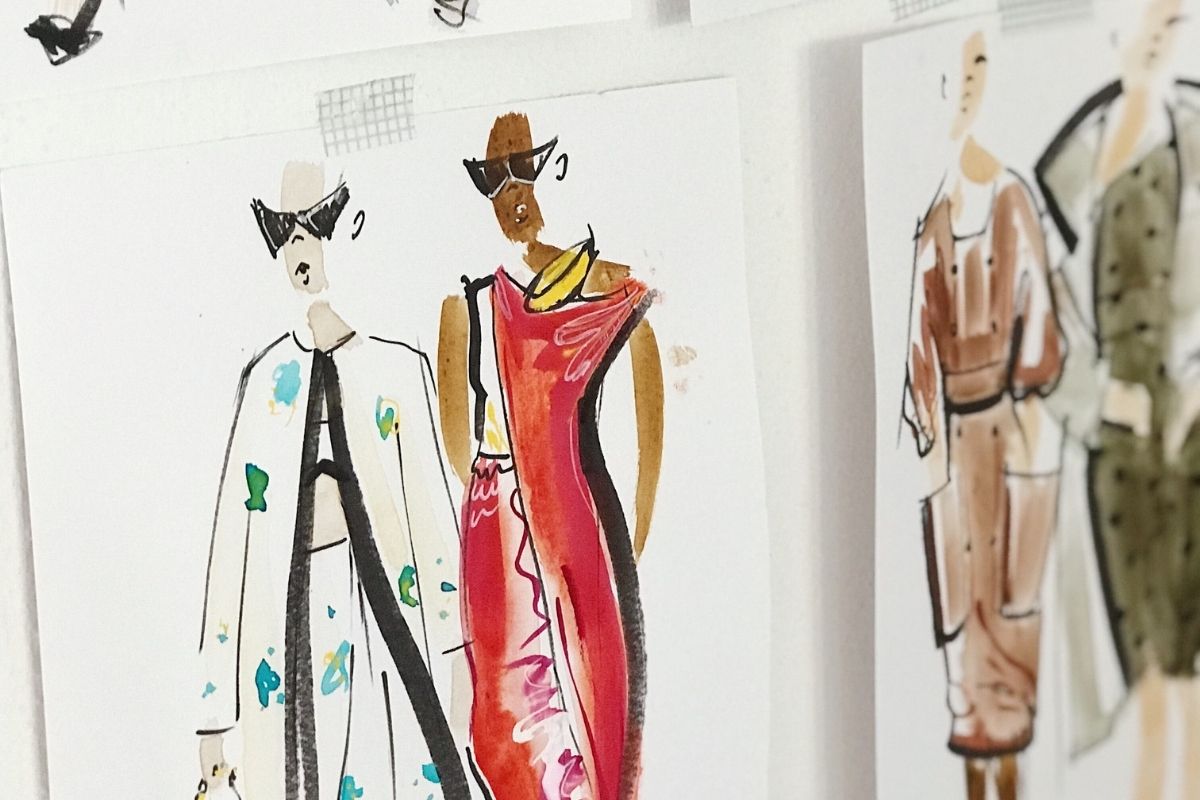
Modern factories are sophisticated. They used to be in Hong Kong and China, and now they are everywhere. They are available almost 24 hours a day. They take your design, turn it around as quickly as they can, and get it back to you.
Most people don’t understand how the factory economy works. It’s very similar to the airline industry. If an airplane is one-third-full, it loses money. When it’s about half-full, it makes money. At three-quarters-full, it makes a lot of money. And if it’s running at 100%, it’s making a ton of money.
The word factory in the fashion business refers to textile mills and sewing factories. A sewing factory traditionally is a CMT – Cut, Make, and Trim. They take the raw material and put it on the table, cut it to shape, and assemble it. They deliver a finished garment to you.
A textile mill is different. It has three functions. They spin the yarn, weave or knit it to shape, and then add the dye.
You deliver that raw material to the CMT factory. Designers will frequently tell the factory, “You buy the raw material for me.” The process becomes a little easier. But, remember that if you provide better inputs, you get a superior product. So, the designer should go to the textile mill and get the correct material. Because if you use sub-standard material and assemble it into a beautiful garment, no one may buy it.
You take a similar risk in the CMT when cutting the raw material. How well you cut the cloth, and how much utilization you get from the fabric is a significant part of this online fashion education course. How you assemble the garment is also an important part of the course.
Working with the Factory: Communicating with Factories

If you’re going to get into the fashion design business, it’s important to completely understand the varying complexities that impact the supply chain. Stick to the parameters of your business plan to get the full picture of its needs—in knowing every detail of your plan, you’ll make the best decisions for your business.

For example, if you’re going to focus on only selling underwear, you might immediately start planning to get your production completed in a hub like Medellin, Colombia. It’s a major manufacturer of underwear and denim apparel, and after locking down plans to source your production there, you may have questions about regular trips to Colombia throughout the year. It’s also worth wondering if fluency in Spanish is required, as you may want to go to the factories and communicate to the team how your product needs to look, wearability concerns, and customer expectations to consider.

Additionally, choosing Medellin as your production hub introduces questions about distributing the final product to America. Currently, Colombia has a free trade agreement with the United States, making it an excellent place to outsource. It also happens to be in the Eastern Time Zone, which is beneficial if you’re based in New York City. A production location that’s based in your time zone will reduce the likelihood of having to take midnight calls—which is often the case for those sourcing products from China, with a 12-hour difference between there and NYC.

The requirements of standardizing production can snowball to involve many small details. It’s crucial to think beyond exclusively sourcing a final piece of clothing. Rather, it’s important to think about so much more: the means of communication with vendors, ease of access to the site location, distribution pipeline quality, as well as current events and political issues.

At the moment in the United States, China is a frequent topic of conversation. We source many consumer goods from Asia, which menas political events can have an impact on your particular business. Understanding the intersection of global politics and economics and how it can affect a small boutique designer in the South reveals how pivotal these decisions can be in the global ecosytem, whether made in Washington, Beijing, Paris, or any other fashion hub.

Working with the Factory: Choosing a Manufacturer

Manufacturing can be overwhelming.

One of the really important things in choosing a manufacturer is not having all pieces produced in one place.

It’s preferable for you to price and source your own garment and all of the pieces for it. For instance, you might have a client who says, “Maybe I should just send this pair of trousers to the manufacturer, or you say, “Can you just match this?”

That’s not going to be an exact match. You didn’t choose the fabric on your own. The manufacturer will go out and get it for who knows how much, and then they’ll just charge you for it. Also, transparency isn’t always guaranteed, and building partnerships with manufacturers take time. So, what you want to do is gather all of those materials on your own. You want to have as much control over your manufacturing process as possible.

Touch and feel each piece. Make sure you know how much it will cost. Negotiate the price of each component on your own. Then, send it all to your manufacturer, who will put it all together for you.

You’ll be curious as to who else they make items for. Sometimes it’s a matter of confidentiality, but a manufacturer will often inform you that they produce for a specific company.

It’s ideal if you can identify a manufacturer who has a track record of producing high-quality products for other well-known companies. It will assist you with quality control.

Another important element to remember is that while you’re sourcing all of those different pieces, you want to make sure that they all make it to the factory and know what to do with the pieces.

To summarize, it is recommended that you price each of those items separately for yourself. Take a look at what the company has already created. Check out who else they’re manufacturing garments for.

Also, while everyone is an expert in some areas, only a few people are experts in all areas. Don’t be afraid to defer to the experts. There’s an expert that creates clothes tags. There’s an expert that makes unique tissue paper for the package. There’s an expert that can finish the trim on your garment. Find your expert. And remember, not everything has to be done in one location.

Cinematic History: An Art, a Technology, Culture: Groundbreaking Films

“Being a student of film since I was 12 or 13-years-old, I just loved films,” says Sam Pollard. “Learning film history was very inspirational and informative in the shaping of my career. I would say anyone who wants to understand the evolution of film history, should first look at two groundbreaking cinema filmmakers.”
One early director’s contribution to filmmaking
“First, is D.W. Griffith. Though politically I have issues with some of his films, specifically Birth of a Nation, Griffith revolutionized narrative storytelling.”
Griffith, with his camera operator, Billy Bitzer, figured out that film was about more than having master shots. It was also about medium shots and using closeups to enhance a scene’s dramatic actions. It was about the interaction between characters.
He also created cross-cutting, parallel editing. These techniques let filmgoers see story, characters and action occurring in one place, before cutting to a storyline happening in another time and place—parallel action.
Eisenstein changed film editing forever
Another seminal filmmaker in the evolution of film is the work of Russian filmmaker, Sergei Eisenstein.
“Eisenstein’s film, Battleship Potemkin, specifically its Odessa Steps scene, was groundbreaking. It had revolutionary editing: from a political perspective, a social perspective, and from a cinematic editorial perspective,” Pollard remarks.
“This film is a must watch for anybody who wants to understand film editing and filmmaking—to watch the Odessa Steps scene repeatedly. I still am inspired and informed by that sequence. “
Another filmmaker who was very revolutionary for being very experimental but also engaging was Vertov’s Man with a Movie Camera.
Dziga Vertov was Russian, like Eisenstein. If you have the opportunity to watch Man with a Movie Camera, you’ll see he takes you sort of behind the scenes, so you see him, the filmmaker, making a film.
This was revolutionary not only back in the 1920s, but still today in 2020.
Very important filmmakers: Eisenstein, Vertov, Griffith.
Great American filmmakers after the silent era
“When we got to the world of sound, where audio became important, some filmmakers really stood out. But first, before talking about these films, one of the other silent filmmakers who stands out, and whose films I just rewatched, is Charlie Chaplin,” says Pollard.
“Chaplin’s sense of cinema, how he created emotion and character. It wasn’t with a lot of frills but just so dramatic and great. If you go back and watch Modern Times and City Lights, the guy was a revolutionary filmmaker.
But again, when you got to the 1930s, after the silent era was over, you had filmmakers like Alfred Hitchcock, John Ford, and George Stevens. These American filmmakers.
Influential filmmakers from around the world
“Later, though by the time I got into the film industry, I understood that it wasn’t only American filmmakers who were important but there were European filmmakers, too,” says Pollard.
Filmmakers like Ingmar Bergman, Robert Bresson, and Jean Cocteau.
“There were also African filmmakers, like Ousmane Sembène from Senegal. Yasujirō Ozu and Akira Kurosawa from Japan. Satyajit Ray from India.”
All of these international filmmakers were very revolutionary, with a real understanding of how to create personal, emotional cinema.
###

Developing the Screenplay: A Story’s Structure

In general, people tend to use a three-act structure when telling a story.

A beginning, middle and end are used to tell the story accurately and in a compelling way. We’ll start by setting the premise and describing the “big thing” that happened to kick-off the story. We’ll also describe the big challenge that has occurred because of the big thing. Then we will move into the middle of the story where we will describe how we go about trying to solve the problem. Then finally, we’ll end with the conclusion and how we solved the problem. Perhaps we’ll include a cliff-hanger if a secondary problem occurred, but overall, the conclusion would wrap up the big thing and big challenge that was outlined in the introduction.

The beginning is always the introduction to the world of the story and the obstacles. There are usually several different kinds of obstacles that balance each other out. There will be interpersonal obstacles, which are points of tension between people, and then environmental obstacles, like the geography of the story. It’s important for obstacles to be balanced. Too many interpersonal obstacles and your story will feel like a soap opera. And although many interpersonal obstacles allow the story to go on for years and years, and works for a soap opera, it is usually not a great strategy for a feature film.

The middle will contain both stakes and obstacles, and how the character overcomes the various challenges that they are met with.

Finally, the conclusion will typically be the final battle with the ultimate opponent. The battle that will determine whether the main character will get to the goal or not, whether they will live or die, whether they will get the girl. It’s important to note that your main character can only be as good as your ultimate opponent. Oftentimes, your opponent can be a broader issue like racism, sexism, or any other kind of ism. The key is that the opponent is really pressing down.

These are the main pillars of putting together a feature film script.

Documentary and Animated Film: Making Documentary

David K. Irving believes that documentary is an exciting form of filmmaking. One of the most exciting things about documentary is that it’s about the truth, and he thinks that’s important. The truth can be very scary. Getting personal and close to the truth is a very rewarding experience for any filmmaker, in David’s view.
The major difference between documentary film and narrative film is that documentary films are usually built during post-production. You do a series of interviews. You come up with a script. You find all the images that you want. But ultimately, it’s based on what images, stories, and interviews you do have in the editing room. David thinks that the documentary often takes shape in the post-production phase.
He says this is very different from a narrative film. Much preproduction can be done in terms of identifying what the shape of the film will be the better. In post-production, it’s a question of realizing that vision. Documentaries are very exciting because they all happen in the moment.
David personally feels there are many different kinds of documentaries. “Cinéma verité, for instance, is a wonderful form of documentary,” says David. He thinks Ken Burns did a terrific job covering the Civil War and baseball to introduce this kind of documentary into the mainstream in American cinema. He thinks it’s become a very popular format for people to enjoy films.
And for David, the major point of documentary film is the same as narrative film. Both types of film have to tell a story.
He’s seen many documentaries that were just a series of interviews and images where there was no edification. There was no climax. The better documentaries are the ones where when you finished watching it, it feels like it’s the end of the story.
[Please embed: https://unsplash.com/photos/KieCLNzKoBo]

Documentary and Animated Film: A History of American Feature Animation

”You have these very early experiments with drawings that move. You have these ideas of taking characters that were either in a comic, or in the newspaper and turning those into animated shorts,” Says Kimson Albert. “For example, Gertie the Dinosaur with Winsor McCay was an early version of animation.”

He had a Gorgo act where he actually interacted with an animated version of Gertie the Dinosaur. Behind him, he would throw grid an apple and all these interactive things. It was very new. It was kind of a novelty thing at that time.

You have the early Disney shorts, and you have early Fritz the Cat shorts. Everything is a mouse or some sort of animal that’s cute or mischievous or any of these things.

Steamboat Willie is a short that’s the first sound short animated short. Before then, you wouldn’t have sound synced to the action, which is a Disney film. This turns everything around. Now that the cartoon has sound to it, we’re in a whole of the universe essentially. Film goes from like a Dark Age and then after one film into this incredibly new territory of sound. Then there’s time to adjust that.

With Disney, he was able to experiment with these shorts, prove the kind of ideas, and prove the experiments that they were working on with movement and character in the shorts. They would do all these incredible things with camera. They would test out things with the facts and everything like that.

Then when it came time to do his first feature, which was Snow White, he takes all of this knowledge and his best animators and effects people and throws them on this incredible project that transforms the entire film industry period. It is the biggest thing at the time. Snow White is the definitive mother of invention when it comes to animated film. If you do your research, you will know that the DNA of all animated film features comes from Snow White and character animation.

The evolution of the animated feature is basically the evolution of the Disney studio. They were the ones who were rolling out the Cadillacs of animation. They were the highest level of quality in terms of character animation, in terms of backgrounds, and in terms of camera.

Developing the Screenplay: Use Your Own Life

”It’s really important to pay attention to the things that are around you, to the people you know, that are happening in your community, that you’re watching on the news, or anything that’s coming into your life, and realizing that those are the kernels, the nuggets of gold for you,” says Caran Hartsfield.

You probably have that uncle, grandfather, auntie, sister, or whoever who was an incredible character. That often gets overlooked. The real people in our lives that are great characters, or those real moments that happen between two friends on a Tuesday. Write those things down. Use those little golden nuggets to create great scenes.

“It’s so much easier to use real people than to make this Frankensteinian, made-up person that you’re really basing on other films that you’ve seen. You have the luck of knowing the people that probably only you know.” Hartsfield explains. “I don’t know them; most screenwriters don’t know them. You know them. I don’t have the life experiences you have. Most screenwriters don’t have the life experience you have. That’s what’s so exciting. We all have the stories that only we can bring.”

“The world is not monolithic. The world is not homogeneous. Art has always reflected life to a certain extent. The notion that it should not be diverse is insane,” says Seith Mann. “I think that there are so many different and wonderful stories out there, and the more diverse the talent base telling those stories is, the more different, interesting stories that you will have.”

We all benefit from hearing stories from multiple voices. From gaining insight from characters and worlds that have a lived experience that is not necessarily our own. Then, at the same time, it’s important for people to see themselves and stories. If you have a marketplace that doesn’t reflect anything but a particular demographic, that makes it harder for different people to identify with those characters. It’s difficult for them to be truly invested in those stories, which is, ultimately, what is behind all the human need that we have for this illumination that comes from storytelling.

In Hollywood, there’s a profit motive. Hollywood’s going to make more money if it draws in a greater audience, and part of the way you do that is to have diverse storytellers telling different stories. It isn’t rocket science.

Developing the Screenplay: The Screenplay

When it comes to developing a screenplay, film director and screenwriter David Irving points to one simple industry expression: “You cannot make a good film without a good script. You can certainly make a bad film from a good script. But to repeat, you cannot make a good film from a bad script.”

Everybody’s looking for a good script. And good scripts are few and far between.

There are different elements to a successful screenplay, as Irving notes. A good script has to be a certain length, proper format, and it has to have a beginning, middle, and an end. It’s a blueprint for the actual film.

It takes a very special person to be able to read through a script and see the movie. A director who reads through the script is putting a lot of brain effort into it — How can I make this happen? How can I realize this particular film?

At the same time, you’re reading through a script to find an emotional arc and connection. Will this be a film that I want to work on for a very long time? Will this film entertain and engage an audience? Will it be of some value to put all that effort into the screenplay? The screenplay is first and foremost the document you need in order to be able to proceed with a film.

While a screenplay may attract a lot of people to a motion picture, it goes through a lot of transitions along the way. You have a first draft, second draft, third draft, polished draft, shooting draft — there are lots of changes that scripts go through to get to the first day of principal photography.

Even during principal photography, that script will change. In post production, that script will continue to change. That’s why you must have a very solid screenplay upfront, and it takes a real professional to be able to read it and see what that movie might be.

Developing the Screenplay: Starting to Write

[Please embed: https://pixabay.com/photos/hand-write-pen-notebook-journal-1868015/]

“You know, it’s very easy to write one script and then talk about it for three years,” says filmmaker Judd Apatow. But according to Judd, successful writers don’t stop there. They stay consistent.

“The people who succeed are the people who write a script and then start the next one the second they’re done,” Judd continues. “When I was first starting up, a friend told me that he sold the tenth script he wrote.” That knowledge helped Judd, who learned that it takes a long time to sell a script. “I’m not supposed to become some famous rich person on the first script,” he realized. “You have to hope it happens early but be willing to write those ten scripts to make it.”

Filmmaker Caran Hartsfield agrees. “It’s an incredibly daunting process, even for professionals,” she says. “And it’s hard to settle in and just go step by step. The first step is to exhale and know that it’s going to be a roller coaster ride.”

Caran also points out that not every writing session comes easily. “There are going to be days when you are so excited that it’s coming together. And there are going to be days of ‘What was I thinking yesterday?’”

On some days, filmmaking and writing can feel out of reach, and writers can doubt themselves. Still Caran offers encouragement for writers. “I’ll tell you a secret,” she says. “A writer writes. If you write, you’re a writer. So just write a little bit more every day, and make that a habit.”

Caran has a friend who commits to writing every day, even if it’s just one sentence. “I think that’s a really good practice,” Caran says, “and it’s something that I have personally incorporated into my own practice. I find that it creates momentum.”