Performing Arts and the Role of the Actor

The role of the actor on the stage of performing arts varies from actor to actor, and everybody has their own methods. Everybody comes in with a different agenda. Everyone has their own background in performing arts education or online performing arts education. Everything is different, and it’s up to the director to pretty much funnel it all in.

Having been raised by a theater director, I was taught and I hold it as what my own beliefs are is that when I go to do a play, I’m there to realize the director’s vision of that play. I’m an interpreter, and as an actor I will interpret the role. And I will come in with what I think the character should do, and how the character should behave, how the character should walk, everything.

Then the director will have his or her very strong ideas about the character, and then the rehearsal process — that four weeks of going into a room with actors, and your director, and the designers — is just, for me, why I do it. It’s an actor’s playground. You get to fail in that space because you don’t have an audience. You get to stretch your instrument. You get to try many different things and explore the possibilities.

Then you’ve got this director with his ideas or her ideas coming at you, and then you have another actor coming at you with who they are. So, maybe a preconceived idea of how I was going to react to a character is different depending on who’s playing the character, and all of you in this room give birth to something nobody could have thought of on their own. And that’s what’s thrilling. That’s creativity. And I could literally not perform at all and just do the rehearsal and be a very happy actor.

Performing Arts Can Take Place Almost Anywhere

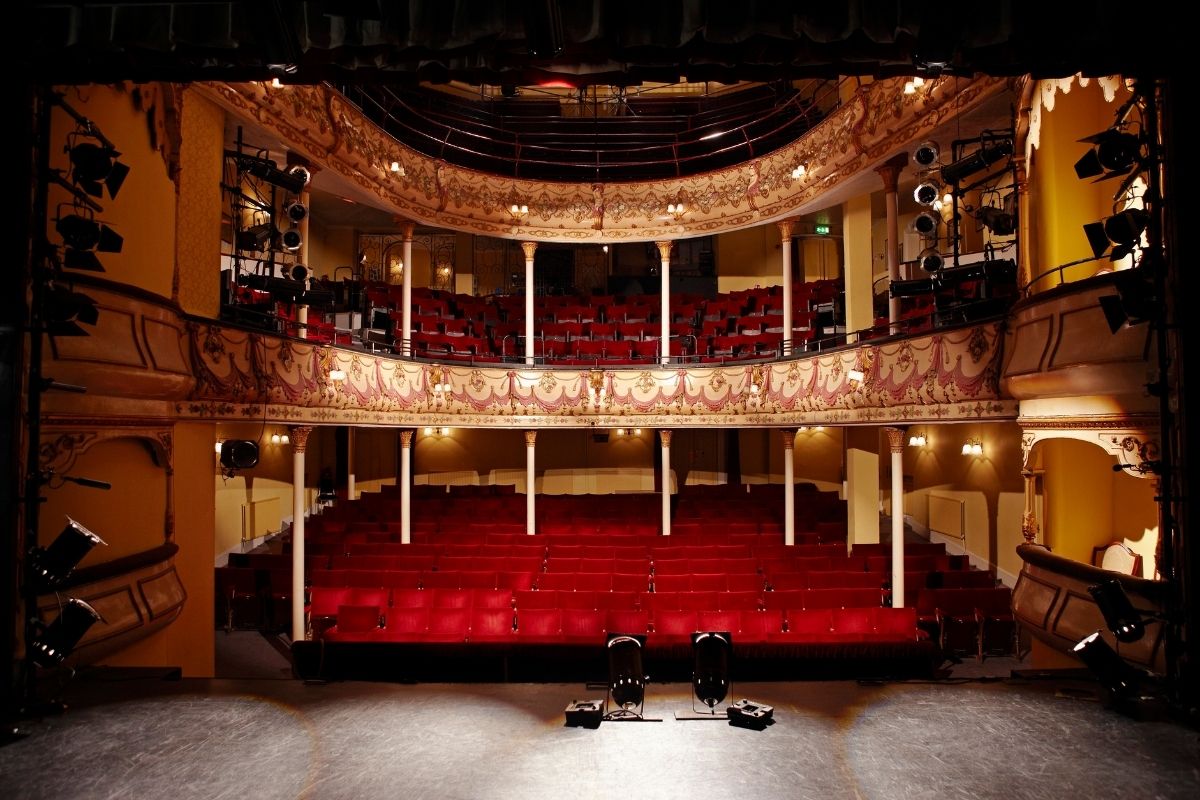
Where does performing arts work happen? There’s a traditional, expected framework, particularly at this moment, that theater happens inside a theater. This idea is especially common in Europe and the Americas. You sit in a chair, and there’s a stage. It’s usually a proscenium stage, which means that there’s an imaginary fourth wall and the audience witnesses a kind of expected tradition.

In your performing arts education, you’ll learn that this inheritance has been disrupted in a lot of ways. For example, you may have experienced theater in the round or theater where you’re sitting on two sides of the stage or there are other configurations of the room. But the room is still localized in a theater.

Ruben Polendo points out that “there’s another kind of work that’s important, as it speaks to location. And it’s the idea of site-specific work.” Intended to disrupt the expectation that work happens in a theater, the idea of site-specific work is that theater work can happen anywhere, Polendo explains. “You can actually identify the site, so it can happen in the forest, in a park, in an abandoned bank. It can happen on a riverbed; it can happen in a lot of places.” So, the site becomes a key factor in the performance.

Immersive theater is a third type that’s important to understand in online performing arts education. Although the language for this has just become important recently, the style has been part of artistic practice for a very long time. Polendo views immersive theater as somewhat in line with the site-specific variety. “It often happens in unexpected places, though it has certainly happened in theaters,” he observes. “The idea is that you’re no longer bound to a sitting configuration, but actually you are immersed in the world of the piece. You’re actually surrounded by it … and your experience is now fully experiential. This is a very exciting kind of work to do.”

Harvey Young agrees. “There’s a liveness factor that is powerful. It’s worth celebrating,” he says. “And so I would say to anyone who is anxious or more concerned about going to the theater, ‘Don’t be.'” He adds that what’s wonderful about American theater is that it really aims to reach the people.

Young offers a case in point: When Amiri Baraka did “Dutchman,” it premiered in Greenwich Village. It drew an art crowd, the generation crowd of the time in the early 1960s. Baraka’s reaction was like, “‘No, no, no, I appreciate that crowd as well, but my people are up in Harlem.’ So he took the exact same production, and he moved it up to Harlem on the streets, and he did it at a street-corner theater.”

That made a huge difference across New York City, Young explains, “because now you had people across the entire island of Manhattan thinking about and living and inhabiting this play. So, that’s what you want. You want theater to be alive.

“A lot of people want to know what it takes to create theater and to start a theater company or put on a play for the first time. It sounds taxing at first. It sounds really difficult. Do I need to get a choreographer? Do I need to rent out a theater, an auditorium?”

Young downplays those concerns. “It’s not that big of a deal. All you need to create theater is a performer, a performer who is willing to perform in front of someone else,” he says, adding, “The basic definition of theater is someone performing before another person. It’s witnessed; it’s audienced. It’s two people sharing space together — one as witness, one as performer.”

As Polendo sees it, “One of the things that makes theater-making so exciting to me is that one of the responsibilities is not only that it’s live, but that it’s actually live in the sense that it’s constantly developing, that it’s consciously taking shape and constantly speaking to its time and of its time.”

Over time in history, Polendo notes, you see all sorts of cultures do exactly that, shaping theater into spaces of ritual or performance. They shape it into spaces where text is important or physicality is important.

“What’s exciting to me is that there is no trajectory of how theater develops,” Polendo says. “There’s this incredible map, and that map has to do with ideas and exchanges and migrations, and it’s there that theater comes alive.” He concludes, “If you want to think of the history of theater, don’t think of a line of theater developing, but think of this incredible map that’s coming from all sorts of directions.”

Performing Arts Education and the Role of the Director

“One of the ongoing complaints that directors of the performing arts have, particularly about theater critics, is that they don’t recognize the work that directors actually do,” explains Elizabeth Bradley. “In other words, critics will look at a production and give actors credit for something that actually was the director’s contribution. Designers will sometimes get plaudits for something that, if the director hadn’t asked for it, the designer would never have come up with it. Actually understanding what it is that directors contribute can be hard to pin down.”

“Everything that is seen on stage goes through the director’s table,” adds Shanga Parker. “Theater, it’s very much a director’s medium. I think film and TV can be more of an actor’s medium, but it’s very much an editor’s medium because that’s the last step a film or TV show gets. It gets written by the writer, shot, and then it’s edited.”

In the theater, every decision that is made goes to the director’s hands and mind. The director gets a script, decides how to cast it, or thinks about right number of roles, male, female, what it’s going to look like. If it’s a family, does the family have to look like a family, or can it be a different racial and ethnic background?

“What kind of story are you trying to tell? If you decide to make it look like a family, that’s saying something. Right? Or you decide to break that up and put it on its head and make the audience look at the play, perhaps, in a new way,” says Parker.

Performing Arts Education on the Meaning of Broadway

What do we mean when we say the word “Broadway?” First of all, we mean that Broadway is a certain way of telling stories and understanding how to tell stories with music. Broadway doesn’t have to be a book musical necessarily. It’s this other kind of thing altogether, and there’s a vitality, a connection, and an energy from within that will never die.

There’s something about shows-topping numbers, there’s something about the spectacle, and there’s something about the flash of Broadway. Combined, we begin to see this hybrid thing that allows for other things to happen. Often, new or unexpected things. When we think about shows like “Oklahoma,” we can recognize these traits.

Performing Arts Done By Musicians

“Tommy” was a musical by The Who. The band wanted to tell a story, but they were also rock musicians, so they combined the two for one ultimate experience. There are other music-heavy shows like this, too. Stew and Heidi did a show called “Passing Strange,” and then there’s the famous show “Hair.” There is a story happening in all of these shows, but you are experiencing them in different ways — often in a way that is closer to a concert.

British Invasion

Americans started to have a greater appreciation for some of the British Broadway shows, including “Phantom of the Opera,” written and produced by Andrew Lloyd Webber. Another favorite was “Miss Saigon,” produced by Cameron Mackintosh. Mackintosh was making large shows that revolved around the spectacle of the theater. His performances were all about singing, dancing, and movement. Of course, they were also about the story, but the spectacle was equally as important.

Music Is Key

There’s both a connection and a separation between the music that folks are listening to on the street and the music in a Broadway musical that takes years to develop. Music is popular because people are listening to it right now, and it’s providing them with something at that moment. When people hear music from Broadway shows like “Tommy” outside of the theater, they question it. “What’s that sound? Where is it coming from? I’m not in the theater right now. I want to see the stories that are told with this sound.”

Because of this, you see many people trying to understand the global power of music. Lin-Manuel Miranda was able to pull all of that together in a way. He has this encyclopedic understanding of the hip-hop and rap phenomenon, and he also has a deep knowledge of the history of American musical theater.

Lin-Manual Miranda put his knowledge of music and history together in a wildly successful story about the founding figures of the United States and the American Revolution. The twist was that the cast was primarily made of people of color. This show was popping because it showed multiple forms and multiple ways to use them. Broadway can hold all kinds of stuff.

Performing Arts Education: What Do You Have?

When starting a performing arts project from the very beginning, it’s important to understand exactly what kind of production you have. It’s very different to produce a piece that needs a very affluent audience, for example, than it is to produce a piece that would be perfectly happy downtown in one of these warehouses. An example might be when I first saw “Little Shop of Horrors” when it was done off Broadway, more like off off Broadway.

The paint was peeling on the walls, the springs were coming through the bald, frayed seats. You felt like you were taking your life in your hands to get down to that part of the East Village. When Audrey sang about somewhere that’s green, you really knew she needed to get somewhere that’s green. What that showed is that the producers of that piece, the creators of that piece, had a really solid understanding of the context that would serve that piece, especially at the beginning.

It often seems that when a young playwright has a first treatment of a script, or a young group of actors comes together and talks about wanting to create a piece of theater on a certain theme, that one member of the team might have one way of describing the theme, and the second, third, and fourth members might have something that was just a little bit different. My response is, “Are you sure you all want to make the same thing?” And again, it’s not about rigidity or making everything homogeneous, but it’s being able to answer that core specific question, “What is it? What is the thing that you want to make, and who do you want to make it for?”

Performing Arts Insights: Mandy Gonzalez & Community Theater

I’m from Los Angeles, California, and I remember there was a performing arts group that I worked with that my grandma found from “LA Weekly” magazine or whatever. It was called “Rock Theater,” and we would sing rock music and theater music. It was my training ground because I was with other students, other young people, that loved what I loved. I was no longer this oddball. I could express myself and sing “Annie” at the top of my lungs and feel like other people would sing along and know the words.

Why am I sharing this part of my life with you today? I think it’s important to have a safe place in your community where you can go to truly express yourself and find acceptance. Theater is that for so many people. I know it was definitely that place for me.

Inspiration Found in Communities

I recently saw “Hercules” at the Public Theater as part of the Public Works program. The musical had professional actors. I had friends that were in it. But, then, the production also had actors from the local community who had never been on a stage before. They had to do their pieces. They had to make this production together.

It was so inspiring. They had people of all ages in it.

I think about it, and I remember myself as a young person. I think about how incredible it would have been to have shared a stage with professionals at a young age and just watch them and learn from them. Although I think it’s so important that Broadway is one stop and one place where incredible theater happens, never forget that amazing theater experiences can happen all over.

It’s important. It’s why I believe it’s important when I do a concert. It’s one of the things that I love because some people who attend say, “I could never make it to New York, but here you are singing this for me.”

Online Performing Arts Education

While pursuing a performing arts education and after, it’s important that you give back to your community. As far as you go, it’s important to look back and also take some people with you. Don’t ever forget where you came from wherever you go in life. Don’t ever forget that the more you give back to your community, the more your community continues to thrive and give back to everyone.

Performing Arts: Jeff Kaplan Talks About “The Black Crook”

I would say that Broadway, in terms of musical theater, started in the 19th century. Most histories of musical theater point to a production called “The Black Crook,” which began in 1866.

It was this extravaganza. It was a five-and-a-half hours show. But people didn’t sit and watch the whole thing. They would see part of it, and then they would go to dinner. They might come back, play cards or throw things at the stage. If you were a theater-goer in 1866, you would also talk a lot. Theater was a very raucous and public kind of activity back then. The modern equivalent would be like you playing a TV loudly in the background.

Why Is “The Black Crook” Important?

“The Black Crook” didn’t really have a plot. It had pyrotechnics. It had all kinds of lighting and stage effects. At that time, theaters kind of resembled navy battleships. The lower levels looked like engine rooms, and they had these massive machines that could change the sets very quickly and do all kinds of amazing things.

“The Black Crook” also had ballet dancers. In the production’s origin story, this troupe of ballerinas were going to perform, and, supposedly, the theater where they planned to perform burned down. Theater fires happened a lot back in those days, especially when using gas lighting in structures made of wood and decorated with fabric.

But, supposedly, this troupe of ballerinas and production were in this theater, and they decided to produce this special dance routine. In it, the ballerinas were naked. I don’t really mean “naked,” but at the time they were wearing clothes considered very, very scandalous for that era.

“The Black Crook” was a very risqué, burlesque kind of thing. And, yet, it went on and on for 474 performances. It was this phenomenon.

Online Performing Arts Education

From “The Black Crook,” we can learn, as performers and other performing arts professionals and students, a lot of interesting things about theater, productions and audiences. We discover that stage effects and taboo displays can sometimes be enough to make a show that doesn’t have much of a plot a huge success. We learn that an interesting origin story makes a production a memorable historical event. During a performing arts education course, we can also learn through historical accounts of mistakes by past theater crews more about important safety concerns.

Mary Ann Kellogg Talks About Flooring in Performing Arts

Let’s talk about flooring and how it impacts a dance.

Let’s say you’re working in tap shoes. Tap shoes, as we all know, have metal on the bottom of each shoe, right? Well, if you’re tapping, then that surface you’re tapping on is important.

Is it tile?
Is it wood?
Is it cork?
Is it slippery?
Is it sticky?

You need to know the answers to these questions to provide the best performance possible.

Furniture can also double as flooring, which means you need to know how all of the onstage elements interact together. These elements are going to give you wonderful choices. If you said, “Oh, I’d like them to dance on that piece of furniture, or I’d like them to tap on that piece of furniture.” Well, you need to make sure that the particular piece of furniture is, first of all, going to allow you to do that instead of unsafe for a dancer to use and a fall or collapse risk.

Performing Arts Education

Your online performing arts education can help you better understand all of the elements of a stage, set or other performance area. It opens your eyes to what you need to take into account to make a performance a success. It can also teach you how to do a better job at protecting yourself and others from common accidents.

Performing Arts: Publicity Insights by Malini Singh McDonald

The publicizing part is actually mostly complete if you are very clear about why you’re producing your show in an elevator pitch and already talking about your vision, strategy and execution plans to people who can help you achieve your dreams and goals. It’s merely a matter of thinking outside the box to find the people who can help you.

Reaching the Right Audience

I didn’t go to school to become a publicist, which means that my training came through real-world, hands-on experiences. One of the greatest gifts that has come my way over the years was the knowledge about how to attract interest in shows. It really is all about who you know in this industry, especially in a time when it’s actually extremely difficult to get reviews.

Obstacles in Every Direction

It’s especially hard to get reviews in New York City. This region is oversaturated. It’s just hard. There are only a handful of reviewers. There are only a few places you can go to actually get what you need in order to make a press kit, which is why you really have to think outside the box.

In my case, I use every possible method I can think of to reach potential reviewers, including postal direct mailers, email lists and social media. I use all of to get the word out.

When using these methods, you need to answer in engaging ways common questions like:

– What is your show about?
– Is there something very unique about your show that would be of interest?

Believe you me, there is a blogger out there who’s interested in that one thing, whatever it is, that makes your show worth people’s time and money. You merely need to explore the possibilities.

Online Performing Arts Education

It’s funny. This morning, I was working on something similar to this discussion in relation to thinking about how we create content. We think that if we can just find the stories, then we’ll be able to get outlets interested in our content.

Publicizing is more than just writing a press release and sending it out to everyone even though you do need to have one. A press release just lets people know what’s going on and when it’s happening. What you need more is the follow up.

To attract that interest, you need to have a clear idea of why you want specific publications, media outlets, bloggers and others, to come see your show. This is where your performing arts education can help you. Your courses can give you the knowledge and tools to come up with these answers and attract interest in your shows.

Never Underestimate the Influence of Props and Objects

“Props are anything that an actor might touch or handle,” Gianni Downs says. “Sometimes you might refer to them as properties. And you can think of them in a couple of different ways.”

Hand props are props that actors will carry around with them. There are set props that may exist in a room, such as a furniture that an actor cannot move on their own. Then there are decorative props, such as curtains hanging on the wall or paintings that may be present. You can think of anything that isn’t built by the carpentry shop as a prop. These are frequently things that you might come across in your daily life.

Is the couch upholstered? What type of upholstery is it? Is it made of wood? Is it made of metal? These elements may tell the audience in a matter of seconds who the individual in a room is or what the play is about. This is considered to be performing arts.

When it comes to staging design, such small changes may significantly influence. And these are the kinds of judgments that a designer must make regularly.

And it is your responsibility to make those decisions. And your choices should be influenced by the program you’re working on as well as the characters that inhabit it. These skills can be acquired through online performing arts education.

Often, there will be a significant meal scene in many older programs. And this may be for a Christmas party or a particular function. A table scene can often serve as the focal point of an entire play.

One props designer told me that mashed potatoes are used in almost all her creations. As a result, she can shape it into a variety of different shapes. She can dye it in a variety of colors.

It’s also simple for people to consume. Furthermore, almost no one is allergic to it. So you’ll often see mounds of different things on a plate that people are eating. And it could be mashed potatoes.

Alcohol is another thing that is very common in the theater. So many shows revolve around people making poor choices. And those decisions are frequently made while under the influence of alcohol.

As a result, a large part of my job as a scene designer is to plan out where the furniture will be placed on the stage. The director and I will work closely together to determine where items will go, how they will be set, and what angle they will be.

Performing arts education helps in decision making. It’s a good idea to consider what kinds of chairs may exist in the environment you’re building. Are there any weapons? Is this a high-backed chair?

And if you’re going to drink on stage, you should drink something that looks like alcohol but won’t get the actor intoxicated. As a result, flat soda is frequently used. Food coloring and water can be used.

It may be fluids. I’ve heard of people using different teas to achieve different hues. And you can come across property designers who have recipe books for various types of booze, whether it’s brandy, whiskey, or something else. You can be seeking something, or the script might be asking for something.