Business Events: Managing Conventions

When we think of MICE, the C in the term stands for conventions or conferences. This is a gathering of professionals who come together to discuss a specific topic. The United Nations General Assembly is a good example.

Conventions come in a variety of types and sizes. A corporate convention is the first type. Companies such as Apple and Microsoft, and any other corporation you can think of organize these. They want to gather their employees, shareholders, or investors to discuss a new product they’re introducing, for example.

However, there is a second aspect of conventions: associations, which are slightly different. Associations are groups of people who come together for a specific interest. Perhaps you have a family member who works in the medical industry, such as a dentist. A dentist will be a member of a dental association, and these organizations provide continuing education for individuals in the field.

Consider this: if a dentist has been out of school for a few years, you want them to be up to date on the newest research and treatments for dental issues.

These types of associations also hold annual conferences, and they can be enormous. The International Contact Lens Association, for example, has a yearly meeting that attracts over 10,000 participants.

Different destinations across the world will compete for the right to host that convention over all others. That’s 10,000 people who will need a hotel room, food to eat every night, shopping, and transportation. It’s a lot of spending for destinations to attract that kind of convention.

Business Events: Managing Corporate Conventions

Conventions play a major role in the hospitality industry. As professionals plan their travels, there’s a lot of specifics event planners need to keep in mind.

Corporate conventions usually take place in the same location every year. For example, if you’re a tech company that is located in Silicon Valley, a lot of your corporate conventions will probably take place in Silicon Valley. It’s very different from association conferences.

Think of my dentist. We have dentists that are located all over the United States. The association that hosts the annual meeting for these dentists will probably want to rotate where the location of the convention will be.

For example, one year it will be in the Northeast and, the next year, it might be in California. It is very important to choose a location that is appealing to people. Because if you, as a dentist, decide where you might get your annual education or training, you might prefer to go to a place like Hawaii over a cold place in the winter, like Detroit.

So, a lot of associations think very carefully about which locations they select and, the destinations work closely with the organizers to attract them. There is also seasonality in terms of days of the week. If we think of conventions, the most popular days for conventions to be hosted are usually Tuesday, Wednesday, and Thursday. Those are peak times. A lot of the venues, such as hotels and convention centers, will be very busy during those times.

The reason is that if you are attending a convention as part of your profession, you want it to take place during working hours, during the working day. You might have to travel to that convention.

If I’m based here in New York and I need to go to a convention in Florida, I might want to leave the day before. So by starting your convention on a Tuesday, it means you give people travel time on Monday. By ending on a Thursday, it means, again, they can travel home on Friday, and they still have their weekend.

Many conventions will also take place anytime between March to May and then again between September to November. Staying away from the main holiday periods. You want to make sure you host a convention at a time when a lot of people are around, not when they’re all traveling or when they’re on vacation.

Business Events: Managing Trade Shows

Trade shows are a way for people to come and see the latest offerings from their favorite companies. Managing trade shows and business events effectively results in revenues for both the hospitality venue and the exhibitors.
Know your attendees
When designing a trade show or business event, you must think about your attendees. There are the consumers who come to visit the venue, and there are the exhibitors that come to present and/or sell their products to a captive audience eager to buy.
Determine how long the trade show will run
You also need to determine how many days that the show will run, and which visitors will be eligible to attend for those days. Some trade shows are open to the public for all days. Other trade shows, like the New York Times Travel Shows, only allow travel trade partners (e.g., travel agents, tour operators, etc.) to attend on the first day, and then opens it up to everyone for the remaining days.
Booth rentals and revenues
The hospitality venue generates revenues via ticket sales from the visitors and booth rentals from the exhibitors. The venue space is parceled out into different areas and rented to the exhibitors, which then bring their magic to fill and transform the space to create an experience for the visitors.
The booth space is especially important. A visitor will generally spend more money at booths located in the center of the exhibition hall rather than a booth tucked away into a corner somewhere.
Each exhibitor and their staff need to think about how they can entice visitors to choose their booth over the others. One idea is to provide giveaways. There are also companies that cater to special lighting or special carpeting for trade shows specifically with the purpose of enticing visitors.

Creating the Dream And Experience: How To Innovate In the Travel Industry

The wheels of travel are constantly going through waves of innovations. When we think about innovation, we think about design thinking. Design thinking is a methodology that helps us develop innovative solutions to pain points.

The reason we talk about hospitality, travel, and tourism from the perspective of the traveler is that we want to empathize with the traveler. Empathy is one of the first steps in the design thinking methodology. It enables you to think about the travel journey from the traveler’s point of view. You can then identify the things that just don’t work, the pain points.

Think about the wheel of travel as if you were the traveler, and go through it from that perspective. For example, identify yourself as a young independent traveler that is traveling alone. Think about that and think about the dream phase. Think about the planning phase, the comparison phase, the booking phase, the travel phase, the experience and stay phase, and the post-trip review phase. Empathize with that young independent traveler throughout the travel wheel. Then identify all the pain points you can think of. Identify the things that don’t work, things that require too much effort with very little payoff, and things you’d like to change.

Once you’ve identified the pain points, think of a solution to fix them. That’s how innovation works. Think of the customer pain points using the design thinking methodology.

(following two paragraphs in blue are optional and may be better to remove)

At the XXX (please insert inaudible name here) Center, all of our programs are rooted in that innovative framework. We’ve designed them with one goal – making people job-ready but also innovative and entrepreneurial.

We have an innovation lab at the XXX (please insert inaudible name here) Center. We would be very happy to take you through our lab that is designed to have our students become the innovators of tomorrow. We also host entrepreneurs that start in a garage with an idea and then scale up to become a larger disruptor in the travel and hospitality wheel. One example is Askblue.

Askblue is an artificial intelligence that takes a deep dive into all of the data available on the cloud. It’s mines that data and enables a completely automated concierge service that is free from any human inputs. It offers concierge services in hotels but also in restaurants.

Imagine you’re in your hotel room and you’re wondering, “Oh, when is checkout time?”

Traditionally, you might call the front desk or find an information sheet somewhere in your room. With Askblue AI, you can simply say “When do I need to check out?” Askblue would then tell you that checkout time is 12:00 tomorrow. Askblue goes into the cloud and takes that information from the hotel website. You don’t have to do the searching, you just have to Askblue.

That’s one of the examples of the innovation that we see every day in hospitality, travel, and tourism.

The wheel of travel is changing and it’s providing a host of wonderful job opportunities. This ranges from existing jobs such as hotel general manager, front of house receptionist, or an investor or a consultant in real estate development..It also includes newer jobs, such as working for social media or the new artificial intelligence companies, ensuring that the customer service takes full advantage of what the data can give them.

Even from the Second World War palace hotels in the ’50s and ’60s, the model of traditional hotels has changed over time. From the internationalization of hotel chains, the proliferation of brands, the emergence of online travel agents, and to the cloud artificial intelligence and machine learning – the wheel of travel is changing constantly.

Hospitality, travel, and tourism is not just fun for the customer. It also can be really fun to experience as part of the business. Whether you want to take on a traditional career or whether you want to be an entrepreneur, there are ample opportunities in the space.

​​

Creating the Dream And Experience: The Experience Relies on Real Estate

The experience phase of the wheel of travel happens in the real world with physical products and services. They all rely on some type of real estate. Whether it is a theme park or driving from an airport to a city center, it is all about real estate. Furthermore, anything that happens at the experience phase relies on some sort of real estate. Staying in a hotel is a piece of real estate. Individuals going to eat at a dine-in restaurant is a piece of real estate.
The Companies That Invest in Hospitality
There are various companies that specialize in the hospitality and travel real estate of the general real estate market.
Some of these companies are the owners or professional investors who know how to invest in and maintain assets, such as hotels. We refer to companies like Host Hotels & Resorts, which emerged after Marriott spun off its real estate. Now, it has become a professional investor and asset manager of hotels.
Another company is Park Hotels, which is a real estate investment trust. They only own and professionally manage hotels. They manage any investments, renovations, and maintenance of the assets.
Consultants in the Hospitality Industry
Many consultant companies actively advise individual owners or investors. They provide various services, including valuation, food and beverage, tax, and debt advisory services. One of these companies is Hotel Valuation Services (HVS). Founded by Steve Rushmore, VHS is a legend in the industry that began in New York. It has spread globally with offices in London, Brazil, Hong Kong, and many more places.
Joes Lae, LaSalle (JLL) does consulting services like VHS but is also very active in brokerage. Brokerage is about making a buyer and seller meet to make the transaction. They advertise hotels and other properties to potential buyers and connect them with the sellers.

Destination Marketing and Placemaking: Activity: Generating Demand and Marketing: New York

Why do people travel? There are so many reasons for travel. It could be for special events, occasions, to see new sites, or just visit an interesting city. Let’s take New York City, for example. One of the greatest global cities in the world.

The idea for global tourism is that people leave their home country to experience something interesting that they can’t experience back home. And if you look at the list of the most popular international destinations — France is number one at 85 million international visitors, followed by Spain, and then the United States, at about 75 million. New York City itself gets about 13 million visitors a year.

So why then, do people come to New York City? It’s an amazing place, for one. Diversity. Different cultures. Chinatown. Little Italy. Koreatown. But, there are also very interesting sites too. Central Park is probably the most popular site because it’s open, free, and provides such a contrast in a park experience. Take for example, a traveler from Finland, who might view Central Park as akin to a Finnish forest in the middle of skyscrapers.

And there’s also the 9/11 memorial and museum. The One World Trade tower. And a lot of museums. The famous Metropolitan (Met). The Museum of Natural History. There are many sites here to choose from. A common travel custom now is for the tourist to act like a local and experience things that the locals do. Consumers find these experiences to be authentic. And that’s something that New York City can offer a lot of.
And now thanks to social media, you don’t even have to do a lot of advertising anymore.

In creating your destination marketing plans, look at various sources that rate and rank the most popular attractions and activities in New York City. You don’t have to choose the most popular ones, but use some criteria to choose the ones that you would actually have as part of your vacation plans. For instance, you’ll be traveling to New York City for one week. Find out what you would do during those six nights and seven days. Then describe this in a one-page memo in terms of the criteria you used.

Destination Marketing and Placemaking: Activity: NYC Luxury Travel (Part 1)

NYC & Company is a destination management organization in New York City that puts together programs that attract tourists to the city.

New York City, industries like hotels, restaurants, retailing, and Broadway shows all come together and finance NYC & Company, which then creates programs for marketing the city abroad.

They have done very creative partnerships with London. They exchange some advertising space on buses in New York City. So New York City buses are promoting London, and the same thing happens in London.

Reasons to come to New York City are plenty: there are attractions such as Central Park, 9/11 memorial museums, and events like the New York City Marathon in the first weekend of November, Fashion Week, and many others.
During these times, it’s very hard to get a hotel room, and even if you do, they’re pretty expensive.

Industries have to come together to make it attractive for consumers to come to New York City, because we compete against the likes of Paris, London, and Tokyo.

Luxury Hotels in New York City
NYC has 14 historic landmark hotels. There are the big ones like the Marriott Marquis, Sheraton, and Hilton, all of which have about 2,000 rooms.

There are also very boutique hotels with up to 20 rooms like the Casablanca library hotel at Times Square.

So how do consumers choose? They usually look at TripAdvisor and see the ratings! Interestingly enough, the #1 rated hotel on Trip Advisor is a small 10 room hotel on 44th Street.

There is a group of small hotels which get very high ratings on TripAdvisor.
Restaurants in New York City
There are about 26,000 restaurants in New York City, many of them in Manhattan. Every year, about 26% of this inventory of 26,000 restaurants closes and something new comes.

It’s a very competitive and creative market! If you want to be an entrepreneur in restaurant business in New York City, you have to create and innovate.

Companies like STL Steakhouse and Jonathan Siegel are at the forefront of innovation. Jonathan Siegel has created an amazing new concept: a steakhouse for ladies, breaking away from the traditional Smith & Wollensky style of older gentleman serving in long white coats and people with huge steaks. Instead, steaks are smaller and there’s seafood.

People come for food, but they also come to see other people. There are also very interesting restaurants that are vegetarian, and you have pockets of restaurants, like in Chinatown, which are very authentic, Little Italy and Koreatown.

While in New York City, you’ll never go hungry! You can get the total culinary experience for the six nights, seven days. This includes breakfast, lunch, and dinner. It’s your choice where you’re going to eat. Variety is key: you can’t be at McDonald’s every day for every meal, even if it’s a Happy Meal.

First, decide on the criteria, and it can differ. For breakfast, it could be maybe grab and go, fast. For lunch, it could be something healthy. For dinner, something where it’s more about the atmospherics, the feeling, the mood of the place, and the food.

In a one-page memo, you can give us the list and links to those restaurants. If you have a favorite dish or have some preferred aesthetics of a restaurant, illustrate that.

Gaming Communities Overview: A Community for Everything

Community is a big component to the gaming industry. According to Maria Hwang, community is essential and one of the most beautiful aspects of games, especially in the modern day.
In these communities people learn how to strategize, how to talk to each other, what not to say, what to say, what was courteous, what was not courteous, and what was the decorum. In a lot of MMORPGs (Massively Multiplayer Online Role-Playing Games) you form groups and teams inside the game and then you do missions together.
Anything you can think of that’s in a game has a community that it’s involved in, where you interact with people around the world at any time of the day. This is a strong aspect of the whole gaming community.
League of Legends is a great example. There’s a new fancy skin with Louis Vuitton that just came out, and now people discuss what kind of skins they should choose and how much to invest on that. That is a community and you’re meeting new people through that.
The Twitch Plays Pokémon is another wonderful example of how communities were generated because of that specific gaming genre. Players realized they needed to talk to each other if they wanted to beat this game. From there they created groups where they could get together and strategize. This brought communities together and it generated all these beautiful online discussions.
It is just an incredible positive affordance that games have because people inherently and intrinsically love to play games. They want to win, and only through shared knowledge via a community can you achieve that. There are outlier games where you can win all by yourself. But it only gets stronger when you talk to each other, plan together, collaborate, and get some tips.

Gaming Communities Overview: Social Affinities and Gaming Groups

Games do very well when it comes to the notion of affinity space, according to educational scholar James Paul Gee. If you like a game like World of Warcraft and you have a strong interest in it, you can visit a site on the internet dedicated to the game. Many such sites exist. And in many cases, the websites link to each other. On these sites, you can join a group of people who share your interests or passion. There are all sorts of activities you can partake in, explains Gee. You can review, strategize, theory craft, and mod. You can even set up gameplay. You can redesign, make apps – there is a wealth of possibilities!

And soon, this affinity space will be recognised as a physical space. If you’re at a conference or playing in a land party, you may be in a physical space, but you could also be in a virtual one. As Gee explains, an affinity space comprises of a group of people joined together by interest and passion, because you can take that interest as far as you want. It’s a place where everybody can teach and learn. You teach what you know well while also learning from others at every level of expertise.

Through affinity spaces, games are not only offering a portal into a world where you can show off your problem solving and use the tools listed above, but they’re also giving you a common identity. Not an identity as an American, or White, or Black, but as a World of Warcraft player – a new type of identity in the world.

There are now affinity spaces for everything you can imagine. And they are not only a very powerful way of organizing learning, but also organizing membership, belonging, and identity. As we’re learning today, human beings only feel safe to others, and happy with themselves if they feel they belong, matter, and can participate. Unfortunately, lots of people in America don’t believe that what they do really matters anymore, or that they really are participating in their society. This mentality can make people physically ill.

In extreme cases, it can also become dangerous, warns Gee. Sadly, human beings will take participation and meaning wherever they can find it. So if they can’t find it in a good cause, they’ll find it in a bad one. White supremacist groups are affinity spaces. So was ISIS. So are all of the tremendous networks of physical and virtual spaces through which rich people hide their money offshore. They’re well organized and the people involved learn a lot from each other. They’re very powerful and they give a strong sense of belonging. But they can be dangerous to us. So, Gee recommends that anyone designing affinity spaces for good intentions such as video games should learn how they worked in-game, because the game designers understand their game’s community and intentions.

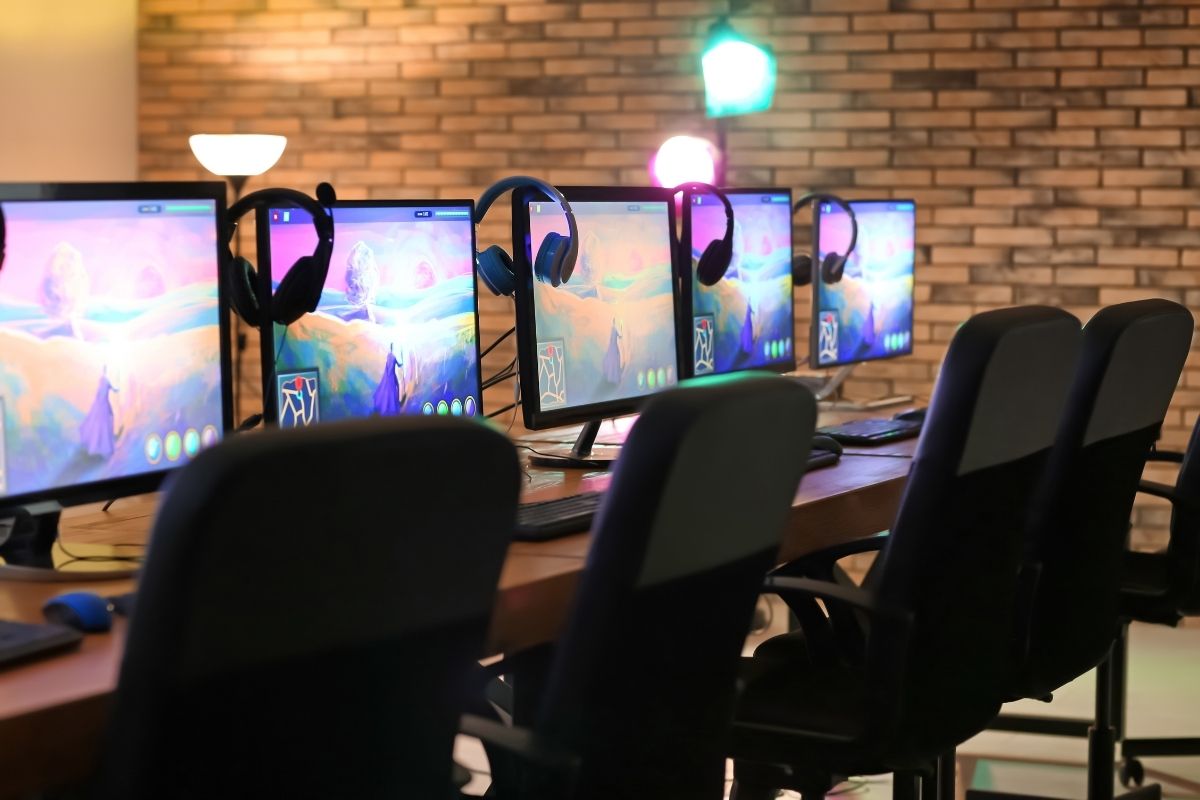
Going & Being Pro: Gaming Gear

If you’re trying to get into esports and competitive gaming, you want to make sure you have the right equipment. This ensures you can perform the best when the time comes for you to compete.
A lot of folks grow up with this idea that playing video games on their television is the best experience or the most optimal. But according to Malik Forté, a 14-year veteran in the gaming industry, the input rate on most televisions isn’t as good as when you’re playing on a monitor, even if you’re playing on a console.
Malik insists that if you switch over from a tv to a monitor you’ll notice that the latency from the time you press a button on your controller to the time you see it play out on the screen is going to be a lot shorter. You will gain a lot more comfort as a player knowing that as you press buttons on your controller the resulting actions are happening with minimum latency.
Outside of the monitor, the most important thing is to make sure the game settings are comfortable for you. The biggest misconception in competitive gaming is that you must follow the top pros’ settings. None of that is true. You need to do what’s best for you and your gameplay style.
Everybody has something different that works for them. Malik Forté plays shooters without vibration because if he is pressing a button and the controller shakes, it hurts his accuracy. Some people need that vibration as a cue for when things are happening to them within the game world. Preferred settings are really case by case. You need to find what is best for you before you decide when it comes to those small mechanical decisions.