Why Associating Music With Existing Genres Aids Discovery

Many emerging artists don’t like to think in terms of genres or classification. They think associating their music with an existing category is impossible. It’s like being put in a box.

If you’re looking for discovery, however, genres are important. Consider streaming services — when you upload your music to a streaming service, you’ll have to put in a genre. While you can start your own “new” genre, there are advantages to sticking with established categories.

Casting a Wider Net

The biggest reason to pick a pre-existing genre is that it helps fans discover your music. Once you identify with a specific type of music, the streaming platform could potentially recommend your song to people listening to that genre.

Online music education teaches us that it’s important to be as honest as possible when classifying your own music. You don’t want to upload a country song to a streaming platform and say that it’s hip hop. In this case, an unsuspecting listener might hear 15 seconds and immediately turn it off. They may then never want to listen to any music like that ever again.

Important for Emerging Artists in the Music Industry

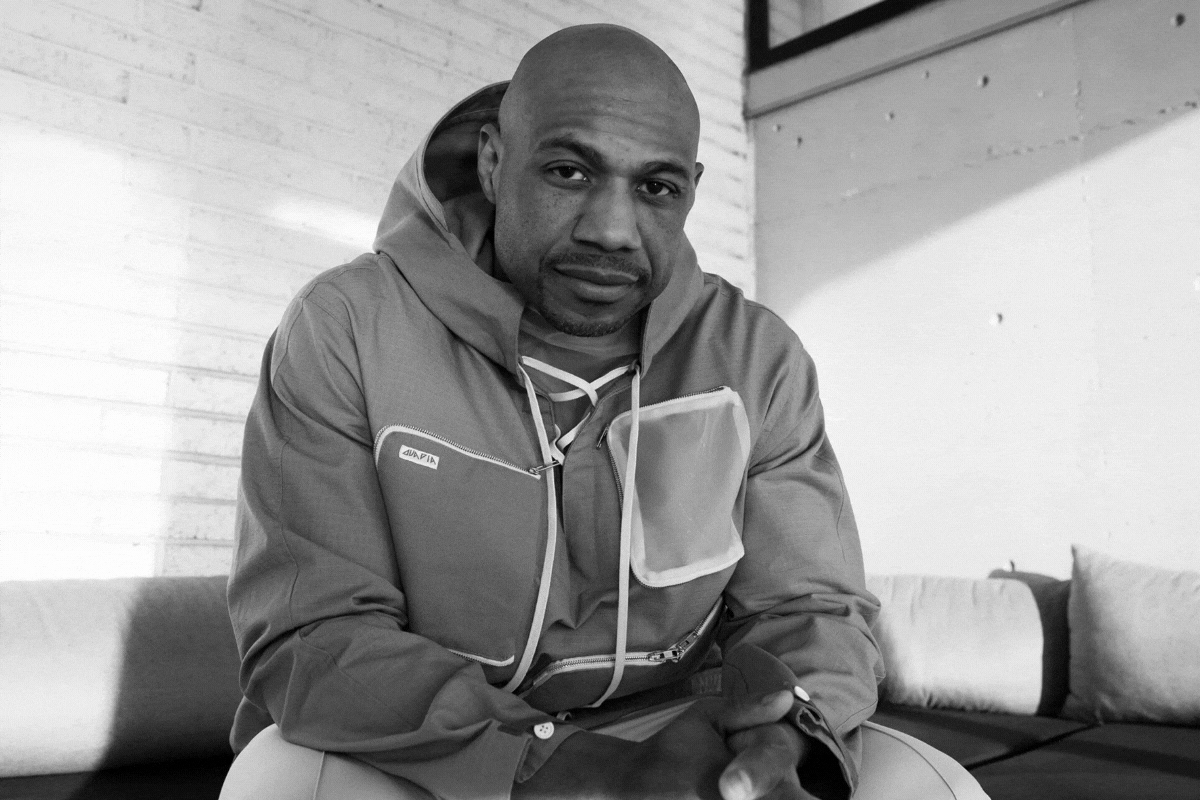
“At least trying to figure out what elements of your music fit into a specific genre can potentially help you to open the door to being discovered in that early stage of your career,” says hip hop artist Ryan Leslie.

According to Leslie, you want people who enjoy music in your specific vein to be able to discover and fall in love with what you create. If you refuse to “put yourself into a box,” then you have to understand the challenges associated with that. It may take you a little bit longer to find your audience. You’ll need to put forth some extra effort to find the relationships and people who want to go on your journey.

Leslie started out making R&B records and felt specifically attached to that musical style. When he did his “Les is More” album, which included a collaboration with Kanye West on a song called “Christian Dior Denim Flow,” that all changed.

“(Kanye) said, hey, make a rap album,” Leslie said “I did a rap album. And now I’m doing a hybrid. I got a new EP. We did a hybrid on that. So really for me, I’m still living in a world of music that I love.”

Even though Leslie “reclassified” his music, he said he still enjoys having artistic freedom. He can utilize his music education and make a straight piano ballad one day and then later decide to work on a hip hop track with some heavy sub bases with trap high hats.

“When you have artistic freedom and you build the audience that’s willing to go with you wherever you want to go, then you have a little bit more latitude,” he said. “I believe at the early stages of your career, though, when you’re looking for discovery, choosing a category of music that allows for you to be discovered in the algorithms on the streaming services is a prudent move to make.”

Writing Music Means Sharing Your Authentic Story

One of the most important parts about this online music education class is understanding what your story is and being honest about it. You know, for me, I grew up in Ohio as a queer woman with a mustache. This story for me hasn’t really changed. It will always be my story.

Now, we have to look at what your story is. We have to find what will never change for you. Where did you grow up? How did you grow up? Writing your first song is usually telling this story to your audience and finding a way to integrate that story into your body for your performance.

It’s important to do this storytelling without the music at first. What I usually do is have my students write down their story. We go through the beginning, middle, and end, and figure out what the real narrative is. Then we develop that into a song, writing out the lyrics and figuring out where they fit. What does the bridge become? And how do we end it? Are we still moving forward? These are important things to consider in music education.

Let’s start by writing a story of our lives. First of all, who is the main character? What do they wear? What do they look like? Where have they come from? Let’s figure out the beginning of that story, the middle of that story, and the end of that story. And this can be any kind of song you want — a ballad, an anthem, a dance track, anything. But we need to figure out where each part lies within the framework of the song and figure out how we move forward in our career in the music industry once this story is written.

What Is a Tech Rider?

The music industry uses a lot of terms that might sound particularly foreign if you’re not familiar with the business. For live performers, one important term is “tech rider,” which includes a stage plot and input list. The stage plot is a picture of all the instruments on stage, the monitor placements, and the names of the people in the band that are taking part in the performance.

That stage plot also includes an input list, which specifies all the different inputs the front-of-house engineer needs to put into the system. These inputs would be anything creating audio from the stage that you want the audience to hear, such as drums, bass, guitar, vocals, keyboard, drum machines, synthesizers, or anything else that makes a sound. Each instrument on the input list should be numbered; this lets everyone talk about each one by its number.

A tech rider includes all of the proper amplification needed for a show to take place. Many people have subwoofers on their tech rider, but they might also use a certain amplitude of speakers and monitors; all of it is meant to help them make sure that they have a professional environment for their show to take place in.

Secrets of the Tech Rider

When a performer is on stage, there are speakers that point back at them. Those speakers play a mix of all the instrumentation that they are most comfortable with while performing. This monitor mix is actually a really cool thing that most people don’t know about unless they’ve pursued a music education; it lets the performer hear their instrument or vocals at their preferred volume level. It makes the performer comfortable knowing they can choose whatever they want their mix to be.

For example, some music performers don’t like to hear their own vocals, but others want their in-ear vocals to be loud. The monitors allow the performer to have the mix that they want separately from what the rest of the venue hears.

In addition to those monitors, there are also in-ear monitors that perfomers can wear like headphones. They’re controlled with a fader system by a mix engineer that’s off to the side of the stage.

What About Backlines?

Another word that you might encounter in your online music education is “backline.” A backline is a list of instruments and gear that the venue offers you when you arrive. This can include mic stands, keyboard stands, amplification devices, guitar stands, microphones, and many other things that the performer may need.

Most venues have a backline section on their website that indicates the things they have available for use by the performers. It’s best to double-check that section before visiting a venue. It’s also a good idea to email the venue before arriving to make sure everything is still on track for the show. It’s always good to have a backup plan in case something goes wrong, as you never know what is going to happen.

What Makes a Good Manager in the Music Industry – do not publish

When it comes to music, following the artist is an important area. We follow the song to begin with. We follow the money of the song. And now we’re going to follow the artist. And what is there to follow, you may ask?

I can’t tell you the number of times an artist comes into my office, comes to talk to me about management or comes in looking for an opportunity and they’re talking about their team. They’ve got their lawyer, their manager, their agent, their publicist, their digital marketing, all of these things. And what I’ll say is, “That’s great. Now, where’s the music?”

We’re going to talk about the right time to find those people to help you out in your career. And we’re also going to talk about what those people do and how they surround the artist. I like to call the artist the orbit because if you think about the globe, and you think about the artists in the middle of that globe, all of the people that are satellites around that globe are the people in the artist’s orbit and the people who are responsible for different areas of the artist’s career. Hopefully, you add those people at the time when you actually need them, as opposed to collecting people’s work for you when there really isn’t anything to do.

First and foremost, the most important member of that team is ultimately the artist’s manager. Now a lot of you are probably wondering how you can know when you’re supposed to get a manager. The answer is you get a manager when you realize that you no longer have time to manage all of the things that are happening in your career. That’s the time to get a manager and not before. If you can do it yourself, then you should do it yourself. If you can’t do it yourself, it’s time to get a manager.

That means when you’re generating income, when you have shows, you have opportunities, when income is coming in and you actually have something to manage. Many artists make the mistake of putting the cart before the horse and getting a manager when there’s nothing really to manage. Once you know you need a manager, the next question is how do you know who the right manager is for you?

In my estimation, the right manager is the most experienced person, and the one who’s the most excited about what you can do and get. In a nutshell, when you have something going on, managers will come to you. When you have nothing going on and there’s nothing to manage, you’ll have a very difficult time getting a manager.

Ultimately, the most important person in your deal is your manager. This is because he or she is the go-between for you and the label. It needs to be a manager who really understands the music business. The manager is the person who wants to turn the artist’s career into ten times more than what they actually have seen. The manager is the one who’s going to be the go-between, the liaison who makes everything run smoothly between the artist and the label, or the artist and Spotify, or the artist and title, or just the artist and everybody.

The artist should be truly focused on making great music. The manager should never want to do that. The manager should just be thinking that they want this artist to be the biggest thing going on in the world and that they’re going to do whatever they can to make that happen. If, as the artist, you don’t believe that someone is going to be that person for you, then that means it’s time to find a new manager. What it ultimately comes down to is that the manager needs to believe in the artist. If they don’t, then they’re just somebody looking for money, and as the artist, you’re going to get screwed.

Online music education is a wonderful way to learn more about what makes a good manager, how to find one, and many more great lessons on finding success in the music industry. And what could be better than a quality music education from the comfort of your own home?

What Makes Compelling Musical Storytelling?

The blogosphere, as it was built, really influenced music journalism. I believe this is because people gravitated toward the blogs because they had a different sense of voice than what a digital publication might have. There was not only a playfulness with these blogs but also a sense of perspective that people really grew to appreciate. And that came in a lot of different forms across a lot of different blogs.

Overall, though, I think there’s a reason why the blogosphere was influential and, to some degree, still is. There is that voice. There’s a kind of perspective that makes you want to engage over and over again, and not just with one piece of content. You want to return to getting that perspective and getting that sense of self you might not necessarily find on a major digital publication.

To me personally, any article that is compelling is a good music journalism piece. There are so many different ways to tell the story of an artist, or a song, or an album, or a trend in music. There are also so many different voices. For example, some of my favorite writers who focus on music sound completely different from some of my other favorites, and I believe that’s because they have a developed voice.

Not only does a great piece of musical journalism need to be persuasive, but it also needs to be compelling. There have been times when I’ve read something that I completely disagreed with, but I ended up loving it because it shed some new light on a topic that I hadn’t previously considered. It was able to add a different sense of perspective, and I always appreciate that as a reader, as an editor, and as a writer myself.

I think that a compelling piece of musical journalism needs to grab your attention. That’s what I mean when I say compelling. It needs to be able to differentiate itself from the sea of coverage, of stories, of posts and of links that make their way online.

At Billboard, that’s what we try to offer every day. We try to offer voices not only within our analysis and our essays and our persuasive pieces of content, but also in terms of our in-depth coverage and our reporting. That can take the form of a reported piece with multiple sources you trust because of the brand name of the writer and the publication. Ultimately, a good piece of musical journalism might come in any of a lot of different boxes, but I believe that overall, it just has to be compelling in some way.

If you’re interested in learning more about music journalism and the music industry, give online music education a try. It is far and away the most accessible way to attain the music education that you desire.

The Importance of Live Performances and Touring in Music

When you talk about revenue streams in the music industry, without a doubt, the biggest source of revenue for the majority of major artists these days is live performances and touring. Live performances and touring, if you think about it compared to traditional spins or record sales, for example, maybe you sell a million records. Then maybe it takes a year to sell a million records. Or maybe you get a million spins, but it takes 10 months, or 11 months, or 12 months to reach those kinds of numbers.

An artist who is getting that level of sales and performance royalties most likely is able to sell out Madison Square Garden. An artist will make more in one night in Madison Square Garden than they will in the first six months of releasing a song. So every big artist realizes that the music is the business card that gets you in the door to touring and really generating that income. Because, at the end of the day, an artist will end up making more money in one month of good strong touring than they will in a year of spins and performances on the radio and likewise. That’s a good bit of music education to be aware of.

The best advice I could give to any aspiring artist is to make your live show fantastic, and the way you make a live show fantastic is to simply play live. There’s no secret. That’s how you do it. The old adage in the music industry is a band who plays 100 shows live is a completely different band from the one who plays their first show. A lot of times when big artists tour, you’ll find that the first couple of weeks of the tour, they’re in playing secondary or tertiary markets.

You might wonder something along the lines of why Rihanna is in West Palm Beach and San Antonio as opposed to New York, Dallas, Boston, Los Angeles, or any other major media mecca center. It’s because artists always want to gather some steam, get the machine running smoothly, get the kinks out of a show, and really make it run well. And in today’s shows, that’s no small feat. Don’t neglect the importance of this as you continue your online music education.

Between the pyrotechnics, the sound, the lighting, the staging, and all the things that go on, it’s really important that all pistons are firing at the same time to make the show great. Now, I understand that you guys aren’t all going to be selling out Madison Square Garden like Drake. You need to make your live show compelling on the club level. It doesn’t matter if there are five people there, 50 people there, or 500 people there. You have to make it kill.

That means you rehearse. That means you build your following. That means you slowly build your audience outside the epicenter of your home base. If you’re a New York-based band, you shouldn’t overplay in New York.

You play a show in Brooklyn, maybe a show in Manhattan. Take a little break. Do you play a show in Westchester? Yes. Maybe try and hit Philly. Maybe you go into Hartford. Maybe you go into Boston. Slowly build your center out. That’s how you build a fan base.

This is a great story that I love to tell. A friend of mine was a manager in Chicago for many years. He was a very big manager and managed a lot of really great acts. Artists would call him all the time in Chicago and say, “Hey, we’re looking for a manager.” And he would say, “Can you sell out the Metro?” For those of you who don’t know, the Metro is a historic club in Chicago.

Every great artist has come through the Metro. It doesn’t matter if you’re the Smashing Pumpkins or Kanye. It’s about a 900-capacity room and very famous. Every great artist who’s come through Chicago has sold out the Metro. More often than not, the artists say, “Well, no, I can’t sell out the Metro. I can sell like 300 tickets.” And he would say, “Well, when you sell out the Metro, give me a call again.”

All this to say you’re not going to be the biggest band in the world if you’re not the biggest band in your hometown. So build your fan base locally. Build those fans, the real fans that are going to stick with you through thick and thin before you try to take over the world. Everybody starts with 1,000 real fans and builds up from there, and you need to do the exact same thing.

Get critical feedback about your show. Make sure your show is great, and when you play, make sure it’s an event. If you overplay, nobody’s going to want to see you anymore. That’s going to have a long-term effect on how you’re going to make a significant amount of money in the music industry if you’re a performer. And if you’re a manager, that’s also how you’re going to make commission.

The Importance of Sheet Music in the Music Industry

The music business begins with music, and the core of the music experience is the song, right? What’s being played by the musician. The song’s at the core of everything we do, and it’s important to understand exactly what a song is. A song is really just an idea. It’s a melodic idea, a rhythmic idea, a harmonic idea. Something that brings a bunch of information together and creates an incredible work of art that can be enjoyed by lots of people.

But the music business starts when that idea first needs to be distributed. For centuries, music was something that was essentially free. It was part of our culture, part of our environments. Songs and music began as oral tradition, as something passed from person to person, and from generation to generation.

The music business starts when the song, the idea, becomes something to sell and to buy. So that’s what I’m going to talk about right now. It’s important to remember that the music business actually starts before there’s anything like records or recording. It actually starts as just a piece of information on a piece of paper. That’s the first bit to learn in your music education.

As we move into the Industrial Revolution and to more contemporary times, it becomes possible not only to fix those musical ideas in form, but also to buy and to sell that form. So the form becomes a humble sheet of paper with that musical information written upon it.

Now, here’s the thing, and it’s really the key to understanding what the business of music is. How much would you pay me for a sheet of blank paper? Next to nothing, right? Because it’s worth next to nothing. Maybe fractions of a penny. It’s almost not even worth talking about because there’s nothing special about it.

Now, I’m going to put some random ink on this paper. How much would you pay me for it now? Still nothing, right? Still pretty much worth nothing. It’s just paper and meaningless ink. The random ink doesn’t really mean anything, so it’s not going to change the value of the paper.

But let’s say I were to write some specific symbols on it, something that you could interpret and understand as a piano player. Then it begins to be worth something, because there is something worth having that’s on this sheet of paper, and now it’s much more valuable. And what’s worth having is the idea, right? The idea of a song. It works the same way for books. Words on a page convey a particular kind of idea, and those ideas are worth money.

And essentially, the early music business was all about putting those ideas on paper. So this is worth more than nothing. It’s worth 50 cents, $1, $2, however much the market will bear for buying sheet music.

Now, it just so happens that the music business emerges and there becomes a market for music in the late 1800s, early 1900s, because there’s an emergent middle class who can afford to buy things like pianos. Well, if you have a piano, and you know how to play music, then you need the instructions for playing that music. So suddenly there is a market for these ideas on paper called songs.

So here’s the thing, if I’m a musician, I definitely know how to make and interpret these symbols. What I might not know, for example, is where to buy a whole bunch of paper to print songs on, or where to buy ink, or the names of all the music stores in America and the addresses so that I can distribute that stuff to them. So frankly, I’m a musician. I want to stay at my piano, I want to compose things. I don’t want to do all that other stuff. That’s when I need somebody else, I need a partner.

So if I’m a songwriter, what I really need is a song publisher. And that is the beginnings of the music business in America, so remember that as you continue your online music education. That’s the beginnings of a music business that started on 28th Street in New York City between Broadway and Sixth Avenue, and it was known by the nickname Tin Pan Alley. The reason it got that nickname is because when people would walk down the street and hear all the sounds of the pianos coming out of the windows as they walked down the street, it sounded like little plunking on tin cans, all these little percussive piano hits that blended into this cacophony of sound spilling out into the world.

Well, Tin Pan Alley is not just a place. It’s also a metaphor and a nickname for the first music business. And the first music business was about selling these ideas on paper, and it was a partnership between the artist and the businessperson, the person who knew how to write these songs and put the symbols on paper, and the person who knew how to distribute and sell them.

This is how folks began making a lot of money. They sold sheet music to music stores, and they also got money for artists performing them onstage called a performance royalty. So this was the nature of the early music business.

The Importance of Song Splits and Registering Your Songs

One of the most important things about revenue streams in the music industry is registering your song. Without registering your song and without having proper songs splits, there is no revenue to collect. That money just sits out there in the ether with really no place to go. That armored car is driving around the parking lot with no hope and no place to stop. How do you solve that?

Every time you write a song—whether you’re writing it with a partner, a friend or somebody else you’ve collaborated with in the past—you should never leave a songwriting session without a song split sheet. It’s a very simple sheet that just says, for example, I wrote 50% of the music, and you wrote 50%, so those are our shares. Without having an effective song split sheet, you’re opening yourself up to a lawsuit. If things go well for you and the song becomes a big hit and you have an argument later on about who owns what share of the song, that money gets held up for as long as the litigation gets held up. You don’t get paid on your song for quite some time.

Song splits can take many different forms. Two people could be a 50-50 split. It could be 95-5. Some songs have seven or eight different writers on them, ranging from 50% for one writer down to 3.5% percent for another. Online music education will show you that Kanye West famously had 21 writers on one song.

Consider “All Day” with music by Kanye West. Kanye sang: “I took a young, sweet breath. And I reached into my head. Gave him what I had left. At that moment I dispersed. At that moment I dispersed.”

Of course, that’s not even including the idea that perhaps you sampled some of a previous song or used a beat from somewhere else. Those rates need to be negotiated as well. So, without a song split sheet, you can’t even register your song. Once you have your song split sheet, and once you are clear on who did what and who contributed how much, you’re able to then go ahead and register your song with a performance rights organization like ASCAP, BMI or SESAC. It’s very important you do that.

You can also then take your song and register it online. All of this can be done online with SoundExchange, for example. SoundExchange collects all your digital royalties for you. Then, of course, when you upload your song to Spotify or Apple, all that information is given there. You’d be surprised how many artists don’t take the first step toward monetizing their music by simply registering their songs with the proper performance rights organizations and collection agencies that are able to get that money for you. It’s a vital part of being in the music industry. If you’re in a situation where you have a major label or you have an indie label on your side and you do have representation like a lawyer or a business manager, they’ll often advise you to do these things. We’re living in a day and age in which music education teaches us that the artist really must take control of their own career. And this is the first step to doing so, making money doing what you love.

The Importance of the Music Supervisor and How To Help Them

Music supervisor is a term for somebody who’s in charge of finding and processing musical information for particular projects. That’s the easiest way to put it. In advertising, they will be called a musical producer or an executive musical producer. But it’s a similar process in terms of what they do.

A musical supervisor will come and say, “I’ve got this deal. This is what the structure is. This is how much we want to pay. Do you have any songs that will work?” And then, we’ll send the musical supervisor some selections.

It’s sort of like throwing darts at a dartboard. I wouldn’t say that it starts against the wall, where you don’t know what you’re doing. It’s throwing darts at a dartboard. And we say, “OK, well, we know what the supervisor wants. We can hit that. We think we can hit it well.” Then, we just basically wait for the supervisor to process it. We just have an ongoing dialogue with them to talk about whether or not it works. If it works, then we do a deal. If it doesn’t, we don’t. It’s fairly simple business, but there’s a lot of intellectual property stuff in the background that’s not quite so simple.

This position is sort of the central point in the music industry for a particular production when it comes to everything musical. Sometimes, that means that they also act as a musical director and not just as a supervisor. And what I mean by that is a musical director, being somebody who will coach actors on how to sing properly for camera, how to lip-sync, or if they need to lip-sync. We’ll work with composers, if needed, to bring together custom work that needs to be done. So there are a lot of things that a supervisor touches on. But really, if you want to think about the supervisor from your perspective, that’s the person to connect with either directly or through a sync agent, a label, or publisher or other entity, to get your music connected to a project and then possibly get it used.

In that role, the supervisor is sort of a central musical point. That’s the easiest way to understand it. Now, there’s one thing I want to talk about here when it comes to supervisors that a lot of people may not know. Basically, the supervisor is only one voice. A lot of the time, they don’t have the ultimate control of approval, or they are not the ultimate decision-maker when it comes to the usage of musical information.

A lot of the time when you’ve submitted musical data to a supervisor, or someone has on your behalf, and it seems like everything’s going well but then it stops, people naturally get really frustrated. And they’re like, “What? You know, the supervisor told us that it was great. I don’t know what’s going on. What’s wrong with these people? They’re totally crazy.”

But they’re not totally crazy. They’re not the person who’s the ultimate decider a lot of the time. The ultimate decider is the person who writes–the people who write the show, the showrunner, the director in a film, or the creative head at an advertising firm. Or it could be a producer, somebody who is at a brand for an advertising company, or somebody high up at the studio in marketing, who just said, “That’s just not resonating with us. We don’t want it.”

So there are a thousand reasons why something that you’ve submitted to a supervisor may not actually happen. I just want to say that, because a lot of people think that the supervisor is like some kind of god. However, a lot of the time, the supervisor is trying to do the best job that they can for their bosses. And the reason that I’m telling you all of this is that there’s an end game for you.

And the end game for you is to say to yourself, “How can I be of service to this supervisor? How can I help them to solve a problem?” That’s your job outside of your music education if you want to step up and deal with supervisors directly. Or a good sync agent would say the same thing, which is, “How do I solve a problem for a supervisor?” And you know what? If you can solve that problem, you’ve got to be honest with yourself about your music and about what you can do, and say, “OK, I can solve that problem!” And then you solve it.

If you can’t solve the problem, don’t send the supervisor something that will set you up for failure. I’ve seen it done time and time again. I see a lot of the time that people will know that a supervisor is busy with several tasks, and they’ll send them musical data that will never work for anything they do, which is the kiss of death in everything.

If there’s a supervisor who is working on a project where everything sounds like it’s very ’80s and you send them some current hip-hop verses, maybe something that sounds like Kurtis Blow or LL Cool J, then you’re going to set yourself up for failure because that’s not what the job of the day is. The job of the sound is to emphasize what the story is. You’ve got to take a look at what kind of stories are being told and what the supervisors are looking to enhance with your contribution. So your creation, as good as it may be, is not always going to be the best thing for the particular job.

Let’s talk from generalities first in terms of how you make your music licensable. Then, we can talk about how you present it because there are two parts of the equation. How you present is extremely important, but before that, let’s talk about what you need to do to make sure that everything is packaged correctly and that when you present it to a supervisor or somebody who’s representing you, you’re truly putting your best foot forward rather than setting yourself up for failure.

Now, the first thing is you’ve just got to create a really good sound. I’m just going to keep on saying that because that’s the most important thing that you need to do. Without really good musical compositions, nothing will happen, so you’ve got to make your sound the best it can be.

Also, you’ve got to make sure that anything that you submit is mastered and mixed correctly. You can’t give somebody something that’s a demo that you’re working on that’s really sort of a rough edit. You’ve got to have things that are ready to go and really represent you the best that they can. That’s probably the most important thing to remember as you continue your online music education, that you have to put in 100% of your effort.

Now, if you do have a relationship with somebody that has developed over time and you’re working on something, then, yeah, of course, just like any other relationship, you can say, “Hey, I’ve been working on this, what do you think? Do you think I should really go for it? Or what do you think of the direction of this?” That’s fine if you have a long-term relationship with a supervisor or with a sync agent or a label or publisher.

But let’s assume you don’t. Make sure that everything is mastered. That’s the number one rule that I’m going to say because I don’t think that people say it enough. They always talk about things like my next subject, which is metadata.

The Microphone’s Impact on the American Music Industry

The pop music industry evolved a specific kind of artist: the recording artist. Whether you’re just beginning your online music education or you’re familiar with the industry, it’s important to remember that the journey of the recording artist begins with another invention, and that invention is called the microphone.

Not only does the microphone enable somebody to have their voice amplified in a venue, but it also enables a performer to fix that performance on a physical form, like a vinyl record.

However, the microphone also does something else: it actually alters the nature of how songs are performed. It used to be that if I were a performer onstage and there was no amplification, I would really have to project so that everybody in the venue could hear my voice. Suddenly, you have a microphone which allows for a greater dynamic range. In particular, a performer can sing very, very softly, and that voice will still carry. In some ways, it allows for a greater degree of intimacy with an artist, as if you are up close with that artist.

That really is one of the things that birthed a new kind of singing: an American singing, a popular music singing. Sometimes it’s called crooning, and there were a few figures of the early music business that really worked that microphone. Whether we’re talking about a Billie Holiday, a Bing Crosby, or a Frank Sinatra, people you might hear about when studying music education, these are some of the earliest superstars of recorded music, and they’re known especially for their subtle nuanced vocal performances.