Lessons: Everyday Chic Collection

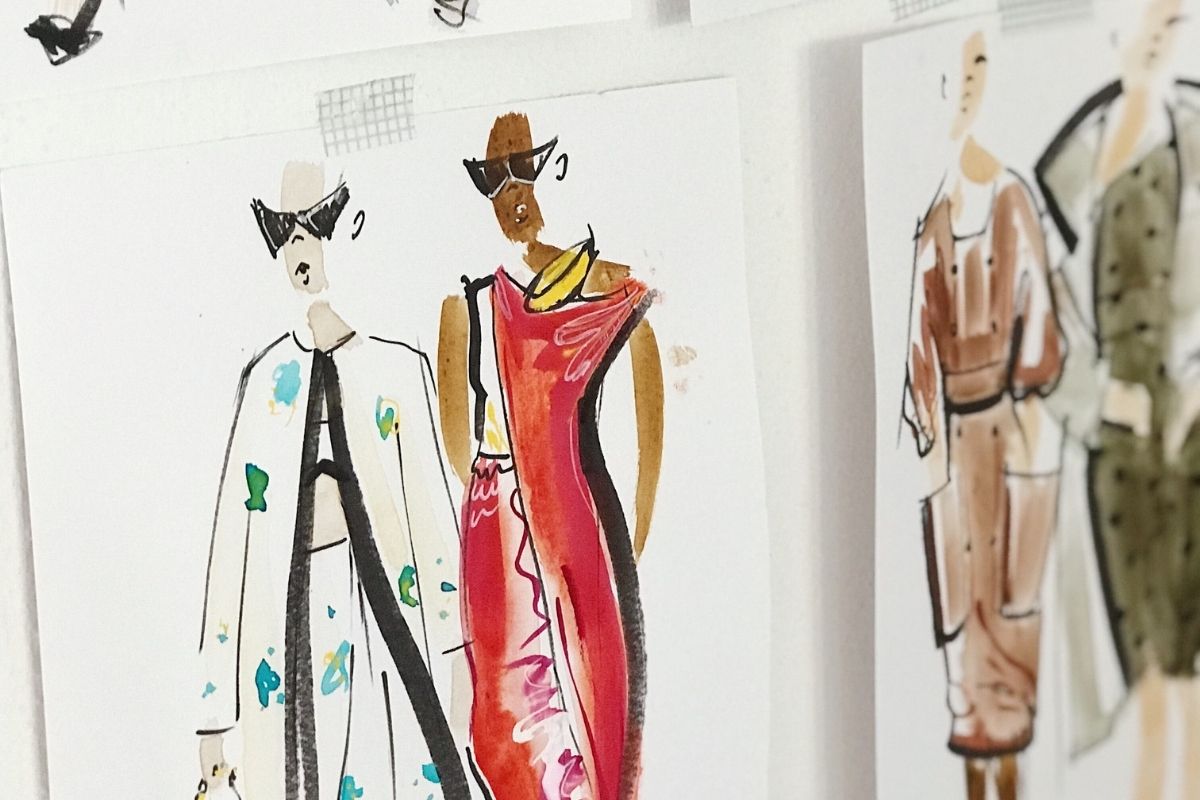
Muriel Favaro is an accomplished artist and associate professor at Parsons School of Design with a few things to share on the subject of creating fashion from everyday objects. This creative pursuit is a way to sharpen your fashion education skills and eye for design using found objects. As fashion business increasingly looks to sustainability, repurposing items is more than a fun trend.

For her homemade chic project, Favaro decided to take a handmade crochet knit and simply put it in the photocopier. She shot screens of the crochet knit and screen-printed the muslin. She repurposed a tissue holder to put all her clips in it and everyday objects for a simple, friendly, and homemade chic.

“In talking about doing always what you truly, truly love – since I was a child, this is my geometry book from when I was 10 years old. I loved geometry. I loved clean lines. I loved colors. And just out of the blue, I discovered that this print I made recently, it’s the exact same thing that I was doing when I was a child. It’s charming.

I also want to speak about my love of what I call everyday objects. I love the tape measure, the scissors, the ruler, pattern paper. I’ve been painting everyday objects myself. So I’ve been painting my scissors, and I have series on all of that. I’m going to just show you some examples.

This is actually a soap grater. I’ve been painting my tools, and it has every stain, every detail of my very used-the screwdriver I took with me when I came to New York almost 40 years ago. My pliers-I came with this pair of pliers also 40 years ago. It has been just a companion in my life. And making it become all of a sudden a piece of art that is going to be noticed on the wall feels really great.” (Muriel Favaro)

Lessons: Factory Prep

[Please embed: https://pixabay.com/photos/rolls-of-fabric-factory-material-1767504/]

“When we’re referring to the production process, it means that you create specifications and tech packs,” explains Angela Gao. “They send it to the factories, and then they’ll follow the instructions to produce the samples in bulk.”

The tech pack, Angela explains, provides precision. “In a standard tech pack, on the left-hand side, you have something that’s called specs, or specification. And on the right, you have an image of the garment.”

The specs include the style numbers, brand, label, and fabrications you want to use. They also include points of measurement.

These specs will help you produce a sample size. Let’s say, for example, that your specs are for a medium. You can set an Excel formula to fill in the measurements for an extra small, extra large, and more. “Usually in this industry, a small size is two inches smaller than a medium size, and so on,” Angela explains.

Angela also points out that your specs should have a standard deviation. “That’s because even though we’re using machinery to stitch these garments, there are still human errors,” Angela says.

The factory can have a deviation of half and inch, a quarter of an inch, or an eighth of an inch in specific areas. However, Angela adds that you probably shouldn’t include standard deviations in a high-end collection, as these garments are made to measure.

After you’ve sent the tech packs and received your samples, the next step is preparing the garments for sale. That process involves a line sheet.

“You could think of a line sheet as a mini Excel spreadsheet,” says Angela. “You can have images of your garment at the top and detailed information, such as pricing, on the bottom. At the top, you can also have your company name, the season, and delivery dates.”

Depending on how many pieces you have in the collection, you might have as many as 10 to 20 pages of line sheets. From there, you can take the line sheet and prepare yourself for trade shows.

Distribution & Fulfillment Channels: Fast Fashion: Distribution Disruption as Business Model

Fashion is changing rapidly and speed to market is a huge part of this transformation. In the past few years in fast fashion we’ve seen a lot of disruption, decentralization, and Instagram monetization.

Think about the original fashion business supply chain and how it’s been set up with department stores and a push model of the industry deciding what’s available and what we’re going to wear. Everyone was shopping in malls to engage with products.

Today, we’re operating more on a pull model where customers can tell us more about what they want. We’ve seen retailers like Zara, Forever 21, and H&M operate in this model of what we consider fast fashion. The real difference is the speed to market and the time it takes for the production process for that product to make its way to a floor.

Zara has been able to innovate and engage with feedback loops and speed up the process to market. Engaging in smaller batch manufacturing is helpful when you’re competing for space on a manufacturing line. It takes more effort and resources to produce 30,000 garments in one place versus spreading out demand in several factories since you’re competing with other retailers and brands to get manufacturing facility space and capacity.

Using fashion education, you can pivot more quickly when you’re dealing with fewer units. There’s opportunities to use customer feedback to shorten production lead time.There are so many points in the supply chain where, when you’re dealing with less units, it becomes easier for stores to more quickly funnel their product.

In historical department store retail, it could take six to nine months to go through this process. Fast fashion really disrupted that process and we no longer have to wait for the season to end to continue iterating, innovating, and ultimately bring newness on our time.

Ecommerce Concepts & Models: Business Website Basics

Today, every brand has a website. They have a web presence of some sort. I believe your website should provide precisely what your customers, or tribe, are looking for.

Many businesses use e-commerce. However, the internet is a bit more educational. You can buy clothes on the web, but first, let us tell you about ourselves. We’ll show you how we sustainably make our products.

It becomes a component of marketing and romancing the customer with who you are and how you conduct business. Nobody wants to be more than a few mouse clicks away from making a purchase. You must make it simple and easy to use.

I believe that user-friendliness is the key. A lot of really high-end corporations, in my opinion, are really good at making attractive visuals. You go to the site, and it’s absolutely stunning, and it perfectly captures the look they’re after. However, if you can’t easily navigate from item to item or see the product’s information, you’ll discover abandoned carts more often than not. Alternatively, they could have simply given up and departed.

We’ve witnessed significant growth in online shopping. Even those I would never expect to embrace e-commerce, such as my parents and people in their eighties, have acclimated to it, and everyone is doing it this way. You’ll want to make sure that your website is simple to use however you put yourself out there.

Ecommerce Concepts & Models: Sales on Social Media

Social media is a world itself. But it also infiltrates the world we live in. I remember 2011 when Instagram first hit the social media scene—it was just a platform you could upload photos to. Who was looking at them? No one really knew. You were following people, but not really following them. Not many brands were on Instagram then, but now, the platform transformed into a marketplace from which you can now gain revenue.
It’s gone from uploading stagnant photographs, to now. Transactions can occur from uploading a single post. It’s phenomenal what Instagram has turned into. It’s changed the way people consume. People don’t just want to see your runway anymore, and say, “Oh, well, I guess I have to wait six months to buy that product, right?” Now, people are like, “I see it, I need to click it and purchase it right then and there, otherwise I’m gonna forget about it.”
Retail channels have become more open in terms of apps. For example, on Instagram, people can click the View Shop option and view the products you are selling, which leads them directly to the website where they can purchase the items. It’s a very easy process. In terms of conversion, I think that you know that our clients either go directly to the website, or we have private clients that buy from us through Far Fetch.
However, I think one of the most important things is to have accessibility. Therefore, the View Shop on Instagram is ideal for me. If someone wants to buy through there, great! It’s about that extra level of accessibility to maximize sales in the e-commerce industry.

Ecommerce Concepts & Models: Wholesale or DTC?

Retail experienced a seismic during the onset of e-commerce. Many people claimed that wholesale was dead, that people were going to open their own stores. Why would you sell? The benefit of selling to a wholesaler is that you can take your product, sell it to them, and don’t have to worry about the product again, right? If it doesn’t sell, you don’t have to worry about what to do with it. You don’t have to worry about marking it down. You don’t have to worry about where you’re going to put it. You don’t have to worry about stock space. You sell it to them, and then it’s their problem—Nordstrom’s problem.
When you operate a store and sell directly to consumers, you must worry where you’re putting the product, where you’re housing the product, paying your employees, keeping lights on, rotating floor sets, all of those things. But generally, you have a bit higher margin when selling directly to the consumer than you would be selling to wholesale manufacturers.
The onset of the internet may have led people to believe, “Okay, I don’t have to have employees. I don’t have to keep lights on. I don’t have to do any of those things, and I can still sell direct to consumers, so it’s a win-win.”
It’s interesting that over the last decade and a half the shift has led to a direct-to-consumer sales model. That has placed some brands in a great position regarding the margin they can charge because if you’re selling directly to consumers, you’re not selling to a retailer that buys at price. A wholesale price, which is usually a markup price. For example, the product is marked at $50, and you sell it to them at $100, they then sell it to the consumer for $200.
So, if you’re selling directly to the consumer at $200, you’d see a 3X margin from what you were making with your wholesale account. And that’s very attractive. Wholesale accounts had been the norm for almost a hundred years. Older brands have wholesale accounts, and it’s been difficult for them to shift to a direct-to-consumer model because of that.

Assignments: Fashion Media

Coming up with a compelling concept for a magazine cover is one important aspect of fashion media. As the editor of Teen Vogue, Amy Astley worked to conceptualize an innovative cover idea based on fashion education, trends, and matching the themes of that month’s publication.

For the August 2015 cover shoot, Astley and her team tied in the theme of going back to school, which often means buying new jeans, and gave the issue an overall denim theme. They decided on creating three different covers, each separate cover featuring one of the three models selected. Each model was wearing denim.

It gives you very quickly the idea that it’s a denim issue, which is why I think they’re impactful and successful, because they’re not confusing. The number one thing is, which pictures do we feel the most strongly about. And again, for me, the driving force is always trying to make the layout and the photo selection memorable, because there are so many images out there everywhere. We’re all inundated with them, not only in magazines, but certainly coming from digital media and just everywhere. There’s a deluge of photos. Instagram – everyone’s a photographer now. But you want your photos to stand out. So that’s why we put so much – lavish so much care on the prep of the shoot and then on this picture selection and the design and the layout, trying to make the whole thing really memorable. (Amy Astley)

Every step of the way in fashion business and media, there are challenges involved in booking the desired talent, beauty, production team, dates, and locations. Astley says it truly takes a village to help make the cover shoot conceptualization come to life. Ultimately, the day of the shoot things often magically come together and they wind up with a memorable magazine cover.

Assignments: Introduction to the Assignments

For stylists and designers starting out in the industry, there is one big lesson to learn: No matter how many creative programs you have completed, nothing can really prepare you for the business side of the industry. You will need to learn the business if you want to build a career.

Many creative people are not necessarily business-minded. Our minds are bouncing everywhere, swimming in different creative ideas. Unfortunately, in order to build a career, you have to know and understand the intricacies of the business. As your business improves and you become fortunate enough to have projects that are not only paying you but the people who work for you—your payroll– you will spend half of your time being creative and the rest of the time dealing with business issues.

Many designers find that as they move deeper into their careers, there are thousands of things that they don’t know, from starting a company to hiring employees to communicating with factories and managing deliverables. For example, one of your first lessons will be coming up with the start-up capital to get your business up and running.

So, while you are spending valuable time conceptualizing and designing a collection, simultaneously you need to keep an eye on the business. It is vital and it is something that nobody teaches you in school.

This course focuses on fashion production, and how production impacts all aspects of the fashion industry. The assignments you will receive are intended to reinforce what you learned in the video lessons. They will give you an opportunity to get practical experience and maybe try something you haven’t tried before. These assignments have been created to help you build your portfolio and your skill set.

Assignments: Visual Style in Fashion

Teen Vogue was always meant to be about the young woman discovering herself, and all the different aspects and facets of herself. For Amy Astley, that core mission hasn’t changed, even as it has evolved with the times. Overall, the photography and the look of the magazine are more sophisticated now. She explains, “That’s because we’ve gotten better at what we do. We’ve grown and become more sophisticated. I’m not even the same person I was when I started it 12 years ago.”

The readers have changed and aged up with the magazine, as well. The core audience is actually in their early 20s. And by giving them a sophisticated product, Teen Vogue has been able to push the envelope over the years and make the magazine more special, sophisticated, and challenging photographically — from not only beauty, but also styling and fashion POVs (point of views) too.

So that’s what the word “teen” means for Teen Vogue — young, fresh, new. But not junior. The magazine itself was mind-blowing for many when it started, and that has only continued throughout the years. For Marie Suter, it’s working with the talents of today that are relevant.

Her first cover with Teen Vogue was Selena Gomez on the beach, and it might have been the third time she had been photographed for the magazine. Marie shares, “So it’s like, OK, what do we do now? We just tried something very different with a positive message for celebrities, about being young and fresh. Selena was a bare beauty on this cover and she looked gorgeous and grown-up.” They did less makeup, less hair. Stripped down the clothes to something simple.

From a design standpoint, Marie made it more grown-up by removing things that would steer the shoot to look a little younger. And all without redesigning or changing the essence of the magazine. So think more evolution in style. Instead of 75 colors on the page, maybe one would be good. Clean it up. Have a very clean cover. For Amy Astley, these are really beautiful. Don’t just go and do the same thing because the cover model always looks good with a red lip. Push yourself outside of your comfort zone.

It’s also helpful to seek out collaborators, especially photographers and stylists, and even the subjects themselves who will help to push you into new territory. Sticking with what you’ve always done is a problem with any creative endeavor. As Marie says, “If it’s not slightly scary, it’s not going to be special.”

How to Design Your Own Accessories

Creating fashion accessories is an art that blends creativity, craftsmanship, and personal expression. Accessories, ranging from the audacious statement pieces to the refined, subtle extras, not only complete a look but also have the power to transform it entirely. This comprehensive guide is crafted to inspire and equip you with the knowledge and skills necessary to start the rewarding journey of fashion accessory design. By weaving in insights from the industry, we aim to guide you through the process of creating accessories that resonate with your unique style and vision.


Gathering Inspiration from the World Around You

Inspiration for accessory design can be found in the vibrant hues of a flower district or the eclectic textures of urban architecture. These environments encourage designers to think outside the box and experiment with shapes, fabrics, and colors. The journey of creating fashion accessories is about pushing boundaries and exploring the playful side of design. Take advantage of your surroundings to fuel your creativity, drawing on everything from nature’s organic forms to the geometric patterns found in city landscapes.


Exploring Plastic, Denim, and More

The choice of materials plays a critical role in defining the versatility and appeal of your accessories. Transparent plastic, for instance, offers a contemporary edge suitable for clear handbags and avant-garde jewelry, embodying the modern fascination with transparency and minimalism. Denim, with its enduring appeal and durability, presents endless possibilities, from chic tote bags to casual wear accessories. However, the adventure of working with materials like untreated indigo denim comes with its challenges, such as the potential for color transfer. A simple yet effective test to determine colorfastness can mitigate this risk, ensuring your creations maintain their integrity and appeal.


The Crucial Phase of Wear Testing

After crafting your accessories, the next step is to subject them to real-world testing. Wearing your creations for a full day will reveal much about their practicality, comfort, and durability. This hands-on approach allows you to identify any issues such as pilling, cracking, or tearing, offering you the opportunity to refine and perfect your designs. It’s a process that marries the creative with the practical, ensuring that your accessories are not only aesthetically pleasing but also durable and wearable.


Take Your First Step Towards Fashion Innovation

For those looking to deepen their knowledge and skills in accessory design, Parsons Fashion Industry Essentials Course at Yellowbrick offers comprehensive training. This course covers everything from material selection to design principles, equipping you with the tools needed to succeed in the fashion industry.

Creating fashion accessories is a journey of creativity and experimentation. By understanding the basics of design, seeking out unique materials, and continuously refining your work, you can create pieces that stand out. Take the first step towards realizing your creative vision – enroll today!